
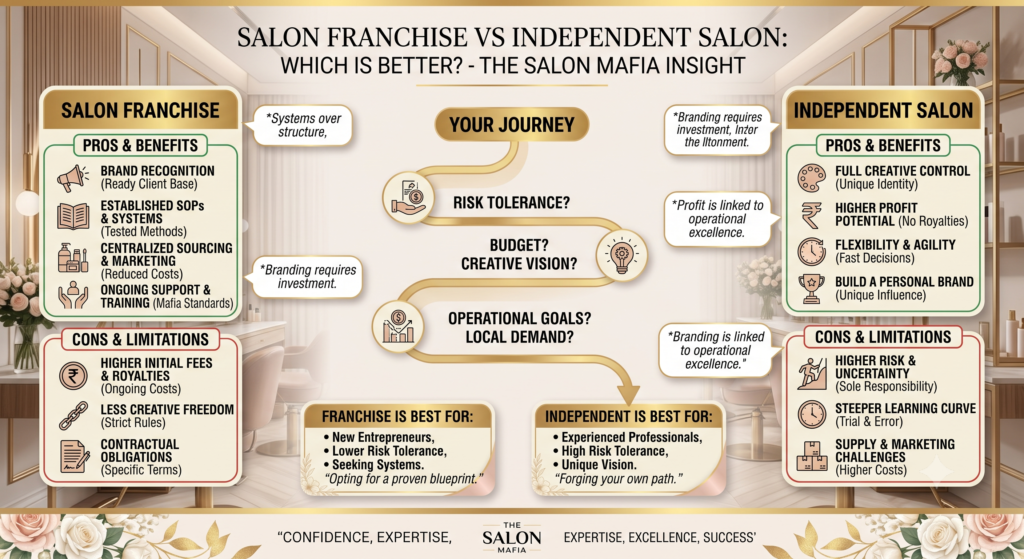
Introduction to Salon Business Ownership
The beauty and grooming industry offers opportunities for entrepreneurs who want to build a business around personal care, hairstyling, skincare, and professional grooming services. From neighborhood beauty salons to premium unisex salons, customers increasingly look for convenient, reliable, and personalized experiences. If you are planning to enter this industry, one of the first decisions you will face is whether to open an independent salon or invest in a salon franchise. Both models can help you establish a business, but they differ in investment structure, branding, operational support, and the level of independence you enjoy as an owner.
For many aspiring entrepreneurs, the decision comes down to a simple question: Should you build your own salon brand from scratch or operate under an established salon brand? An independent salon gives you the freedom to create your own identity, set your prices, and manage your business according to your preferences. A franchise offers access to an established brand identity, operating procedures, and potentially valuable training and marketing support. However, these benefits often come with franchise fees, royalty payments, and contractual obligations. Understanding these differences is essential before investing your savings or arranging business financing.
The Indian salon industry includes businesses of different sizes, from compact neighborhood salons to premium establishments offering hair, skin, nail, and grooming services. According to a 2026 industry guide published by FranchiseTV, India’s beauty and salon market is projected to cross ₹1.2 lakh crore by 2028, although projections depend on the assumptions used. This creates an interesting environment for entrepreneurs, but a growing industry does not guarantee that every salon will succeed. Your location, service quality, customer retention, operating expenses, and management decisions will all influence your results.
In this guide, we will compare salon franchises and independent salons, explain their advantages and challenges, and explore how The Salon Mafia can fit into your salon business plans.
Understanding the Two Salon Business Models

Before comparing costs and profitability, it helps to understand what each business model actually involves. Both franchises and independent salons provide beauty and grooming services, but their ownership structures and operating arrangements are different. These differences affect everything from the salon’s name and interior design to its marketing strategy and financial obligations.
What Is a Salon Franchise?
A salon franchise is a business arrangement in which an entrepreneur receives permission to operate a salon using an established brand’s name, identity, and business systems. The entrepreneur, known as the franchisee, generally invests in the outlet and manages its daily operations according to the franchise agreement. The franchisor provides the brand license and may offer training, operational guidance, marketing materials, interior design standards, and other forms of support.
For example, someone opening a salon franchise may receive assistance with selecting a location, designing the salon, training employees, and planning a launch campaign. The specific services depend on the franchisor and the terms of the agreement. In exchange, the franchisee may pay an initial franchise fee and recurring royalties or marketing contributions.
The biggest distinction is that you own and operate the franchise outlet, but you do not own the entire brand. You must follow the contractual requirements governing how the business operates. These requirements may cover service standards, approved products, pricing policies, branding, staff training, and customer experience.
A salon franchise can be particularly relevant to entrepreneurs who want a structured business model rather than developing every process independently.
What Is an Independent Salon?
An independent salon is a business established under the owner’s own brand and operating structure. The owner decides the salon’s name, visual identity, services, pricing, interior design, marketing strategy, and customer experience. There is no franchisor collecting royalties or controlling the business through a franchise agreement.
This model gives entrepreneurs considerable flexibility. An independent salon owner can introduce a new service, experiment with promotional offers, change suppliers, or redesign the salon without seeking approval from a franchisor. The owner also has the opportunity to build a distinctive local brand that reflects their personal vision.
However, independence comes with responsibility. The owner must develop operating procedures, recruit and train employees, manage inventory, create marketing campaigns, and establish a reputation in the local market. Mistakes in these areas can increase expenses and slow the salon’s growth.
For an experienced hairstylist with an established customer base, an independent salon may provide a natural path toward business ownership. For a first-time entrepreneur, it may require more research, planning, and hands-on involvement.
Salon Franchise vs Independent Salon: Key Differences
The differences between these two models become clearer when you compare their financial and operational characteristics. A franchise provides access to a business system in exchange for fees and contractual commitments. An independent salon offers greater freedom but requires the owner to develop the systems and reputation needed to attract and retain customers.
The following table summarizes the main differences.
| Business Factor | Salon Franchise | Independent Salon |
|---|---|---|
| Brand identity | Uses an established brand | Builds its own brand |
| Initial investment | Includes franchise-related costs | Depends on the owner’s chosen setup |
| Royalty payments | Usually applicable, depending on the agreement | No franchise royalties |
| Marketing | May receive brand-level marketing support | Owner manages marketing |
| Training | May include structured training | Owner arranges training |
| Business systems | Existing procedures may be provided | Owner develops procedures |
| Pricing flexibility | May be subject to brand rules | Generally controlled by the owner |
| Supplier selection | May involve approved suppliers | Owner chooses suppliers |
| Creative freedom | Limited by brand standards | Greater flexibility |
| Customer acquisition | Brand recognition may help | Local reputation must be developed |
| Expansion | Depends on franchise terms and available capital | Owner controls expansion strategy |
| Business ownership | Owns the outlet, not the franchisor’s brand | Owns the independent business and brand |
Neither model guarantees profitability. The value of a franchise depends on the quality of its support and the total cost of operating under its brand. The value of an independent salon depends on the owner’s ability to build a recognizable identity, deliver consistent service, and manage expenses.
Investment and Startup Costs
Investment is one of the most important factors when comparing a salon franchise with an independent salon. Your total budget should cover much more than the initial interior work or franchise fee. You must account for equipment, rent deposits, employee salaries, product inventory, marketing, licenses, and working capital.
In India, the cost of opening a salon varies significantly according to location, size, service range, and positioning. A compact neighborhood salon may require a smaller investment than a premium unisex salon with multiple treatment rooms and specialized equipment.
A 2026 salon business guide published by TrimHub estimates that independent studio salons and franchise studios can have different investment requirements, with franchise costs generally reflecting the additional brand fee and setup requirements. These figures are indicative rather than universal.
Initial Investment and Setup Expenses
A franchise salon typically requires an initial investment that includes the franchise fee, interior setup, equipment, and other opening expenses. Depending on the agreement, the franchisor may specify the interior design, furniture, signage, equipment, and product suppliers.
These requirements can help maintain consistency across franchise outlets, but they can also limit your ability to reduce setup costs.
An independent salon allows you to determine the scale of your investment. You can start with a compact space, select equipment according to your budget, and gradually expand your services as the business develops.
However, lower initial costs do not necessarily mean lower overall business risk. If you choose an unsuitable location or underestimate working capital, you may face financial pressure even with a relatively modest setup.
Here is a simplified comparison of the expenses involved.
| Expense Category | Salon Franchise | Independent Salon |
|---|---|---|
| Brand or franchise fee | Usually applicable | Not applicable |
| Interior design | May follow brand standards | Owner chooses the design |
| Salon equipment | May require approved equipment | Owner selects equipment |
| Rent and security deposit | Required | Required |
| Staff recruitment and training | May include brand assistance | Owner arranges recruitment and training |
| Product inventory | May require approved suppliers | Owner chooses suppliers |
| Marketing | May include a brand contribution | Owner sets the marketing budget |
| Working capital | Required | Required |
Before investing, prepare a detailed budget that separates one-time expenses from recurring operating costs. Keep sufficient working capital to cover the early months when customer bookings may be inconsistent.
Ongoing Costs and Royalty Payments
A franchise agreement may require monthly royalty payments based on revenue, fixed fees, marketing contributions, or a combination of these charges. Some brands also require franchisees to purchase products through approved suppliers.
These expenses can affect profitability, particularly during the early stages of a salon’s development.
An independent salon does not pay franchise royalties, allowing the owner to allocate that money toward hiring skilled professionals, marketing, equipment upgrades, or business expansion.
However, independent owners still face substantial recurring expenses, including rent, salaries, utilities, consumables, advertising, and maintenance.
The important question is not simply which model has lower fees, but which model delivers sufficient value for the money you invest.
Branding, Marketing, and Customer Acquisition
Brand recognition can influence how customers discover and evaluate a salon. When people recognize a salon’s name, they may already have an idea of its service standards, style, and price range.
A franchise can benefit from an established identity, shared marketing campaigns, and brand-level promotional materials. These resources may help a new outlet introduce itself to a market more efficiently than a completely unfamiliar business.
However, brand recognition does not automatically guarantee bookings. Customers still evaluate the quality of the services, the behavior of employees, the cleanliness of the premises, and the overall experience.
An independent salon must build its reputation through local marketing, customer recommendations, online reviews, social media, and consistent service delivery.
This can take time, but it also gives the owner the opportunity to create a brand that reflects the preferences of the local community.
For example, an independent salon in Aligarh could develop a strong identity around premium hairstyling, bridal makeup, or personalized grooming services. A franchise in the same market might use its established branding and service standards to attract customers who recognize the name.
Both businesses must still focus on customer satisfaction and repeat visits.
Operational Support and Business Management
Managing a salon involves much more than providing haircuts and beauty treatments. Owners must coordinate employees, appointments, inventory, billing, hygiene, customer service, and financial reporting.
A franchise may provide a structured operating system that helps the owner manage these responsibilities. Depending on the brand, this may include staff training, service protocols, inventory guidance, marketing calendars, and performance monitoring.
Such support can be useful for entrepreneurs who have limited experience managing a salon.
An independent salon owner must build these systems personally or hire professionals to develop them. This requires time and attention, but it also allows the owner to customize procedures according to the salon’s needs.
For instance, an independent salon can introduce flexible appointment policies, create customized membership programs, and develop its own employee incentive structure.
A franchise may also offer these features, but the franchise agreement determines how much flexibility the owner has.
In either model, effective management depends on clear responsibilities, regular financial reviews, employee development, and consistent service standards.
Profitability and Return on Investment
Profitability is a major consideration for anyone investing in a salon business. However, it is important to distinguish between revenue, operating profit, net profit, and return on investment.
Revenue represents the money generated from services and product sales. Profit is what remains after expenses are deducted. Return on investment measures the financial return relative to the capital invested.
A salon franchise may generate strong revenue because of its brand recognition and operating systems, but royalty payments and other fees can reduce the amount retained by the owner.
An independent salon may avoid franchise fees, but it must invest in marketing, employee development, and systems that help the business attract customers.
Illustrative Financial Comparison
Consider two hypothetical salons, each generating ₹6 lakh in monthly revenue.
The franchise salon pays a 10% royalty, while the independent salon does not pay franchise royalties.
| Financial Item | Franchise Salon | Independent Salon |
|---|---|---|
| Monthly revenue | ₹6,00,000 | ₹6,00,000 |
| Illustrative royalty | ₹60,000 | ₹0 |
| Revenue after royalty | ₹5,40,000 | ₹6,00,000 |
| Other operating expenses | ₹4,00,000 | ₹4,30,000 |
| Illustrative operating surplus | ₹1,40,000 | ₹1,70,000 |
This is a hypothetical example, not a forecast or a representation of actual salon performance. It assumes the independent salon incurs ₹30,000 more in other operating expenses, illustrating how differences in operating costs can affect the comparison.
The example also excludes taxes, financing costs, depreciation, and other potential expenses. Actual results will depend on the business model, location, service mix, and management decisions.
Before investing in a franchise, request realistic financial projections and verify them against actual operating data from existing outlets.
Advantages of Owning a Salon Franchise
A salon franchise offers a structured approach to business ownership. Instead of creating every element independently, the entrepreneur can use an established brand identity and a business system developed by the franchisor.
One potential advantage is access to an established brand. Customers who recognize the brand may be more willing to explore a new outlet, particularly in an unfamiliar location.
Another advantage is the availability of training and operating procedures. A franchise may provide guidance on service delivery, customer consultations, hygiene standards, staff management, and daily operations.
Franchisees may also benefit from shared marketing resources, promotional campaigns, and brand-level customer engagement initiatives.
For entrepreneurs who want to operate multiple outlets, a franchise system may provide a framework for maintaining consistent standards across locations.
However, these advantages depend on the franchisor’s actual capabilities. Before signing an agreement, investigate the quality of its training, marketing support, supply chain, and franchisee relationships.
A franchise should be evaluated based on the support it genuinely provides, rather than promises made during the sales process.
Advantages of Owning an Independent Salon
An independent salon gives the owner greater control over the business’s identity, operations, and growth strategy.
The owner can create a distinctive salon concept, choose a target audience, and design services according to local demand. This flexibility can be valuable in markets where customers have specific preferences that are not fully addressed by larger brands.
Another advantage is the absence of franchise royalty payments. The owner can decide how much to spend on marketing, employee training, equipment, and expansion.
Independent ownership also allows the business to build its own reputation and customer relationships.
For example, an independent salon can introduce a specialized bridal makeup service, develop a loyalty program, or create a premium grooming experience without seeking approval from a franchisor.
However, these freedoms come with responsibility. The owner must develop a recognizable brand, create reliable operating systems, and establish a customer base.
An independent salon can become a valuable business asset, but building that value requires consistent management and long-term planning.
Challenges of Both Business Models
Every business model has limitations, and salon ownership is no exception.
Franchise owners must understand the financial and contractual obligations associated with using another company’s brand. Franchise fees, royalties, marketing contributions, and approved supplier requirements can affect operating margins.
The owner may also have limited control over pricing, branding, service offerings, and promotional campaigns.
Independent salon owners face a different set of challenges. They must build their brand from the beginning, develop marketing strategies, establish service standards, and create employee training systems.
They may also need to spend more time researching suppliers, negotiating with vendors, and developing business processes.
In both models, employee retention is a significant operational concern. Skilled hairstylists, makeup artists, beauticians, and grooming professionals contribute directly to customer satisfaction.
Poor location selection, inconsistent service quality, weak financial management, and insufficient working capital can create difficulties regardless of the ownership structure.
A salon’s success depends on how effectively the owner manages the business, not simply on whether the salon operates independently or under a franchise.
How to Choose the Right Salon Business Model
Choosing between a franchise and an independent salon begins with understanding your experience, financial position, business goals, and preferred level of involvement.
If you are a first-time entrepreneur, you may value the training, operating procedures, and guidance offered by a franchise. However, you should verify that the franchisor provides meaningful support and that the total investment fits your financial capacity.
If you are an experienced hairstylist with an established customer base, an independent salon may allow you to build on your existing reputation while maintaining control over pricing and operations.
Your location also matters. A recognized brand may offer an advantage in an unfamiliar market, while an independent salon may benefit from strong relationships within an established local community.
Consider the following questions before making a decision:
- How much capital can you invest without putting your personal finances under pressure?
- Do you have experience managing a salon or beauty business?
- Do you already have a loyal customer base?
- Are you comfortable following brand standards and contractual requirements?
- Can you manage marketing, recruitment, and operations independently?
- Do you want to operate one outlet or build a multi-location business?
- How much working capital will you need during the initial months?
Write down your answers and compare the financial projections for both models.
Why Consider The Salon Mafia Franchise?
The Salon Mafia is a premium unisex salon brand concept associated with a distinctive, bold identity and a modern grooming experience.
For entrepreneurs exploring salon franchise opportunities, The Salon Mafia offers a brand concept built around professional hair and beauty services, customer experience, and a recognizable visual identity.
The franchise model can be relevant to investors who want to establish a salon under an existing brand rather than develop a completely new identity.
However, the suitability of a franchise depends on its actual terms, operating support, investment requirements, and business performance.
What Makes The Salon Mafia Concept Distinctive?
The Salon Mafia’s identity is built around a premium salon atmosphere and a bold visual style.
A salon business operating under this concept can focus on creating a consistent customer experience through professional service delivery, trained employees, organized operations, and a recognizable brand identity.
For potential franchise partners, it is important to understand the specific services and support included in the franchise arrangement.
Before investing, request written details about the following:
- Total investment and franchise fee.
- Royalty structure and marketing contributions.
- Salon space and location requirements.
- Interior design and equipment specifications.
- Staff recruitment and training support.
- Marketing assistance and launch planning.
- Territory protection and expansion rights.
- Agreement duration, renewal conditions, and exit provisions.
These details will help you determine whether the franchise structure fits your financial resources and business objectives.
Who Should Explore The Salon Mafia Franchise?
Entrepreneurs interested in the salon and grooming industry may consider exploring The Salon Mafia franchise if they want to build a business around a distinctive unisex salon concept.
Potential franchise partners should evaluate their available capital, preferred location, management experience, and willingness to follow brand standards.
An investor who wants to operate the salon personally may have different requirements from someone planning to hire a professional salon manager.
Similarly, an entrepreneur interested in opening multiple outlets should understand the brand’s expansion policies and the operational resources available to support additional locations.
The most important step is to evaluate the actual franchise agreement and business economics before making an investment commitment.
Steps to Start Your Own Salon Business
Whether you choose a franchise or an independent salon, a structured launch plan can help you organize your investment and prepare for daily operations.
Step 1: Research Your Target Market
Begin by studying the local salon market. Identify existing competitors, understand customer preferences, and evaluate the demand for services such as haircuts, coloring, skincare, bridal makeup, nail care, and grooming.
Pay attention to customer spending patterns and the services that generate repeat visits.
Step 2: Prepare a Realistic Business Plan
Your business plan should include the total investment, projected revenue, operating expenses, staffing requirements, marketing strategy, and working capital.
Prepare conservative, moderate, and optimistic financial scenarios.
Avoid relying entirely on projected revenue figures supplied by a franchise sales team. Verify assumptions using local market research and, where possible, actual operating data.
Step 3: Select the Right Location
Location can influence visibility, accessibility, customer convenience, and rental expenses.
Consider residential neighborhoods, commercial markets, shopping areas, and locations with suitable parking and public access.
Before signing a lease, assess the surrounding competition, expected customer demand, and total occupancy cost.
Step 4: Complete the Legal and Administrative Requirements
Determine the registrations, permissions, and compliance requirements applicable to your business and location.
Depending on the business structure and state requirements, these may include business registration, Shops and Establishments registration, GST registration where applicable, local trade permissions, and fire safety compliance.
Consult the relevant authorities or a qualified professional to confirm the requirements for your premises.
Step 5: Recruit and Train Your Team
Hire employees with the skills needed for your service menu.
A salon may require hairstylists, beauticians, makeup artists, nail technicians, reception staff, and a manager, depending on its size and services.
Develop clear expectations for customer consultations, hygiene, appointment management, service quality, and employee conduct.
Step 6: Build a Marketing and Customer Retention Strategy
Create a marketing plan that introduces the salon to the local community.
Use social media, online business listings, customer reviews, referral programs, and local promotional campaigns to attract customers.
Focus on building repeat visits through consistent service quality, convenient appointments, and customer relationships.
Step 7: Monitor Performance and Improve Operations
Once the salon opens, track its financial and operational performance regularly.
Important indicators include monthly revenue, average customer spending, repeat booking rate, employee productivity, service costs, customer feedback, and operating profit.
Review these figures regularly and adjust your business strategy according to actual results.
Common Mistakes to Avoid
One common mistake is underestimating the total cost of opening a salon. Entrepreneurs sometimes focus on the interior budget or franchise fee while overlooking rent deposits, salaries, marketing, inventory, and working capital.
Another mistake is choosing a location based only on appearance or foot traffic. A visually attractive property may still be unsuitable if the rental cost is too high or the local customer base does not match the salon’s services.
Franchise investors should avoid signing agreements without carefully reviewing the royalty structure, territory rights, renewal conditions, and exit provisions.
Independent salon owners should avoid launching without a clear brand identity, service menu, pricing strategy, and customer acquisition plan.
Both types of owners should prioritize employee training and customer experience. A salon’s reputation can suffer when service quality is inconsistent or customer concerns are handled poorly.
Finally, avoid assuming that a franchise automatically guarantees profitability or that independent ownership automatically produces higher margins.
Careful planning, realistic financial projections, and disciplined management are essential in either business model.
Conclusion
Choosing between a salon franchise and an independent salon is an important decision for anyone planning to enter the beauty and grooming industry.
A franchise offers access to an established brand and may provide training, operating systems, marketing support, and business guidance. In return, the franchisee generally accepts additional fees and contractual obligations.
An independent salon offers greater control over branding, pricing, services, and business strategy. However, the owner must develop the systems, reputation, and customer base needed to establish the business.
The right approach depends on your financial resources, professional experience, location, management preferences, and long-term goals.
For entrepreneurs interested in a distinctive premium unisex salon concept, The Salon Mafia is an opportunity to explore as part of their franchise research. Before making a commitment, evaluate the franchise agreement, total investment, operating support, and realistic financial projections.
Ultimately, a successful salon is built through consistent service quality, customer trust, effective management, and careful financial planning.
Frequently Asked Questions (FAQs)
1. Is a salon franchise better than an independent salon?
Neither model is universally better. A franchise may offer brand recognition, training, and operating support, while an independent salon provides greater flexibility and control. The right choice depends on your budget, experience, and business goals.
2. How much investment is required to open a salon in India?
The investment depends on the salon’s size, location, services, and business model. A compact salon may require a smaller budget, while a premium salon or franchise may require substantially more. Prepare a detailed budget covering setup costs, rent, equipment, staffing, and working capital.
3. Do salon franchise owners have to pay monthly royalties?
Many salon franchises charge recurring royalties, which may be calculated as a percentage of revenue or as a fixed fee. Some also require marketing contributions. The exact payment structure depends on the franchise agreement.
4. Can I open an independent salon without prior experience?
Yes, but you will need to develop a sound business plan and learn how to manage staff, finances, customer service, marketing, and daily operations. Hiring experienced professionals and obtaining appropriate training can help you prepare.
5. How can I explore The Salon Mafia franchise opportunity?
You can begin by requesting information about the franchise investment, location requirements, brand support, royalty structure, training, and agreement terms. Review the financial projections carefully and speak with existing franchise partners, where available, before making an investment decision.