
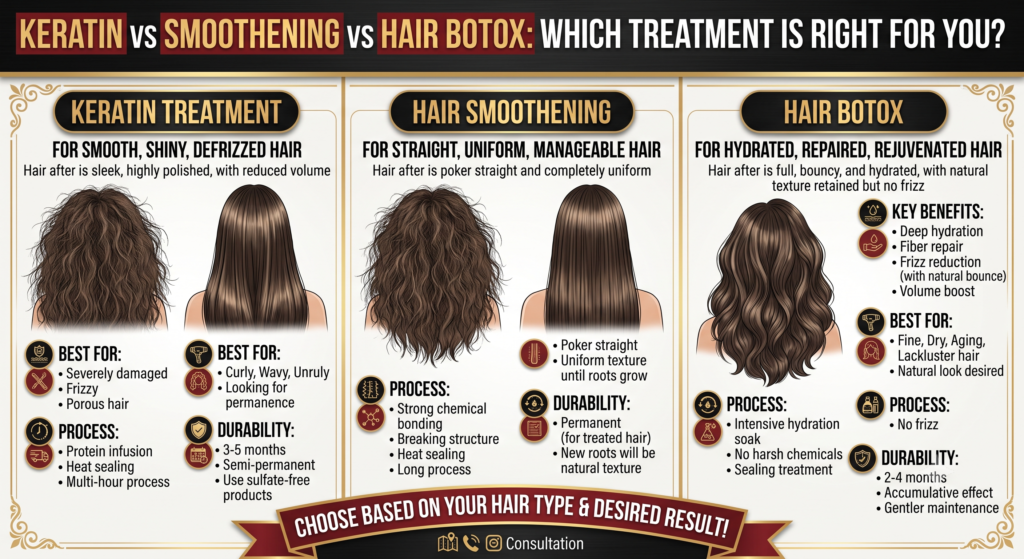
If you have been sitting in a salon chair wondering whether you should choose keratin, smoothening, or hair Botox, you are definitely not alone. All three treatments are marketed as solutions for frizz, dryness, rough texture, difficult styling, and unruly hair, yet they do not produce exactly the same result. One treatment may be more suitable if your biggest problem is humidity and frizz, while another may make more sense if your hair feels dry, porous, dull, or heavily processed. The confusing part is that salons sometimes use these names loosely, and formulas can vary significantly from one brand or professional system to another.
The easiest way to understand the difference is to stop thinking of these treatments as three versions of the same service. Think of them as three different tools in a hairstylist’s toolbox. Keratin treatments generally focus on smoothing and reducing frizz, traditional smoothening services are usually designed to create a more controlled and straighter texture, while hair Botox is commonly positioned as a conditioning and cosmetic treatment intended to improve the look and feel of damaged or tired hair. The exact result, however, depends on the formulation, heat application, starting condition of your hair, and the technique used by your stylist.
There is another factor that should never be ignored: the ingredients. Some hair-smoothing products can release formaldehyde when heated, and regulatory agencies such as the FDA and OSHA advise consumers and salon professionals to pay close attention to product ingredients, ventilation, labeling, and safe handling. That means choosing a treatment should not be based solely on the photograph you saw on Instagram. You should also understand what is being applied to your hair and how the service is being performed.
Why These Three Hair Treatments Are Often Confused
The confusion begins because the desired outcomes overlap. A client may say, “I want silky hair,” while another says, “I want straight hair,” and a third says, “My hair is damaged and I want it to look healthy again.” A salon may have three different services that appear to produce similar before-and-after photographs, even though the chemistry and intended results are different. Hair that has been smoothed will naturally look shinier and more manageable, while hair that has received a conditioning-focused treatment may also look smoother and healthier.
Marketing terminology makes the situation even more complicated. “Keratin,” “smoothening,” “Brazilian treatment,” “botox,” “repair treatment,” and “anti-frizz treatment” are not interchangeable scientific terms. The name on the salon menu does not tell you everything about the actual formula. Two services with similar names can have very different ingredients and processing instructions, so asking the stylist to explain the exact product is much more useful than relying on the treatment name alone.
The Main Difference Between Smoothing and Repair
A simple way to think about the treatments is to separate texture control from hair conditioning. If your priority is reducing frizz and making your hair easier to style, a smoothing-oriented service may be considered. If your hair is extremely dry, porous, dull, or cosmetically damaged, your stylist may instead recommend a conditioning or repair-focused approach.
That does not mean a treatment can literally rebuild severely damaged hair back to its original biological condition. Hair is a non-living fiber once it has emerged from the scalp, so cosmetic treatments primarily improve its appearance, feel, manageability, and surface condition. This distinction matters because realistic expectations are one of the biggest parts of getting a satisfying salon result.
What Is a Keratin Hair Treatment?
A keratin hair treatment is a professional smoothing service designed to make hair appear smoother, shinier, and more manageable. Keratin is a structural protein associated with hair, but the salon treatment is not simply “adding keratin back into your hair.” Commercial formulas can contain combinations of conditioning ingredients, proteins, polymers, acids, silicones, and other components designed to improve the hair’s cosmetic appearance.
The treatment generally involves cleansing the hair, applying a professional formula, allowing it to process, and then using controlled heat to help produce the desired smoothing effect. The exact procedure varies according to the product system. Some keratin services are intended mainly for frizz reduction and manageability, while others create a much straighter appearance.
For someone who spends significant time blow-drying, straightening, or fighting humidity-related frizz, the attraction is obvious. Instead of starting every morning with a battle against your hair, the treatment can make the styling process feel considerably easier. But the result should not be assumed to be identical for every person. Your natural curl pattern, previous chemical treatments, porosity, density, and the formula selected all influence the final appearance.
How Keratin Treatments Work
The smoothing effect comes from a combination of the product formulation and heat-based processing. Rather than imagining the treatment as permanently replacing the structure of every strand, it is more useful to think of it as changing the way the hair behaves and reflects light.
After treatment, hair can feel softer and appear more polished because the surface is smoother and more conditioned. The reduction in friction can make brushing and styling easier, while a smoother surface can reflect light more evenly, producing the familiar glossy appearance associated with salon smoothing services.
One important point is that “keratin treatment” does not automatically mean “formaldehyde-free.” Some hair-smoothing products may contain formaldehyde, formalin, methylene glycol, or other substances capable of releasing formaldehyde during heating. The FDA specifically advises consumers to check ingredients and ask salon professionals about the product and its safety information.
Who Should Consider Keratin?
Keratin may be worth discussing with a professional if your main concerns are frizz, difficult styling, excessive puffiness, humidity sensitivity, or a desire for smoother-looking hair. It can be particularly appealing for people who want a more polished finish without necessarily seeking the most rigidly straight result possible.
It may be less appropriate to make an immediate decision if your hair is extremely fragile, recently bleached, heavily over-processed, or showing significant breakage. In those situations, the priority should be a professional assessment rather than simply choosing the strongest smoothing service.
What Is Hair Smoothening?
Hair smoothening is a broad salon category that generally aims to make hair straighter, smoother, more controlled, and easier to manage. Depending on the specific technique and chemical system, smoothening can alter the appearance and behavior of the hair more significantly than a conditioning-focused treatment.
The word “smoothening” is particularly tricky because different salons can use it to describe different chemical services. One salon may use the term for a keratin-based service, while another may use it for a stronger texture-altering process. This is why the service name alone is not enough information.
If you want smoothening, ask your stylist exactly what product and process will be used. You should understand whether the service is designed primarily for frizz reduction, semi-straightening, or a more permanent change in texture. The distinction is important because stronger texture-changing processes can have a different impact on already compromised hair.
How Smoothening Changes Hair Texture
Traditional chemical smoothening can produce a noticeably straighter and more controlled appearance by changing how the hair’s internal bonds behave. The precise chemistry depends on the system being used, and this is one reason professional consultation matters.
The advantage is obvious for someone who wants a straighter appearance with less daily styling. Instead of repeatedly using a flat iron, the hair may remain substantially more controlled until new growth appears or the treatment gradually wears off.
The trade-off is that chemical and thermal processing can place stress on the hair fiber. If the hair has already experienced bleaching, repeated coloring, heat styling, or previous straightening, adding another chemical process without assessing its condition can increase the risk of dryness and breakage.
What Is Hair Botox?
Hair Botox is a cosmetic hair treatment, not the same thing as injectable Botox used in medical or aesthetic procedures. Despite the name, most hair Botox services do not involve injecting botulinum toxin into the hair. The term is primarily a marketing description for formulas intended to make hair appear smoother, fuller, softer, shinier, and more conditioned.
Formulas vary widely between brands. A salon may use a blend containing conditioning agents, proteins, amino acids, oils, polymers, or other ingredients. Because the term is not a single standardized chemical formula, two “hair Botox” services can produce noticeably different results.
This treatment is often promoted toward people who feel that their hair has become dry, dull, rough, porous, or difficult to manage. Instead of aiming for maximum straightness, the emphasis is commonly on improving the cosmetic appearance and feel of the hair.
How Hair Botox Differs From Traditional Botox
The biggest difference is surprisingly simple: hair Botox is not injectable Botox. It is generally a topical cosmetic treatment applied to the hair shaft. The name refers to the idea of “filling” or smoothing imperfections in the appearance of the hair rather than delivering botulinum toxin.
That distinction is important because consumers sometimes assume that a hair Botox treatment has the same mechanism or medical credentials as injectable Botox. It does not. You should evaluate it as a cosmetic hair service based on its ingredients, formulation, processing method, and expected result.
Who Can Benefit From Hair Botox?
Someone with dry-looking, frizzy, dull, porous, or cosmetically damaged hair may find a conditioning-focused treatment more relevant than a strong straightening service. If your goal is to make your hair look polished while retaining much of its natural movement, this type of treatment may be worth discussing with your stylist.
However, “repair” should be interpreted carefully. A cosmetic treatment can improve softness, shine, manageability, and appearance, but it cannot turn severely broken hair into completely untouched virgin hair. If your ends are splitting extensively or the hair is breaking during brushing, trimming and a customized professional hair-care plan may be more appropriate than simply adding another chemical treatment.
Keratin vs Smoothening vs Hair Botox
| Feature | Keratin | Smoothening | Hair Botox |
|---|---|---|---|
| Main goal | Frizz reduction and smoother hair | Straighter, controlled texture | Conditioning, shine and smoother appearance |
| Straightness | Low to high, depending on formula | Usually higher | Usually low to moderate |
| Natural movement | Often retained to some degree | May be reduced | Usually more natural |
| Best-known benefit | Manageability | Texture control | Cosmetic conditioning |
| Suitable for frizz | Yes | Yes | Yes |
| Suitable for severely damaged hair | Requires professional assessment | Requires extra caution | Often chosen for conditioning-focused goals |
| Result depends on formula | Very strongly | Very strongly | Very strongly |
| Maintenance | Professional aftercare recommended | Professional aftercare recommended | Professional aftercare recommended |
The table gives you the basic picture, but there is no universal winner because your hair has its own history. Someone with thick, coarse, humidity-sensitive hair may have a completely different requirement from someone with fine, bleached hair. Your desired result also matters: “I want pin-straight hair” is a very different request from “I want my natural waves but without the frizz.”
Which Treatment Gives Straighter Hair?
If straightness is your primary objective, a smoothening-oriented treatment will generally be the category you discuss first with a professional. Keratin treatments can also reduce curl and produce a straighter appearance, but the degree depends heavily on the specific product and technique.
Hair Botox is usually not the first choice when the client wants a dramatic straightening effect. Its appeal is more closely connected with softness, shine, manageability, and a smoother appearance.
The smartest approach is to show your stylist a photograph of your desired result rather than saying only “straight.” Straight can mean sleek but natural, relaxed waves, visibly smooth hair, or completely flat hair. A good consultation translates your visual expectation into a realistic treatment plan.
Which Treatment Is Best for Frizzy Hair?
For frizz, all three categories may potentially help, but the right option depends on what is causing the appearance of frizz and what you want afterward. Keratin is frequently selected specifically for frizz control and smoother styling. Smoothening can reduce frizz while producing a straighter result. Hair Botox can make rough, dry-looking hair appear smoother and more conditioned.
Think of frizz as the symptom rather than the diagnosis. Humidity, damaged cuticles, dryness, curl pattern, porosity, friction, heat damage, and improper product selection can all contribute to a frizzy appearance.
If your hair is naturally curly and you actually love the curl but hate the puffiness, you may not want a strong straightening service. A lighter smoothing or conditioning strategy could preserve more movement while making the hair easier to manage.
Which Treatment Is Better for Damaged Hair?
This is where you should slow down before choosing a service. “Damaged hair” does not automatically mean “get hair Botox.” Your stylist needs to determine how severe the damage is and whether your hair can safely tolerate the required chemical and heat processing.
Hair that has been repeatedly bleached or chemically treated may have reduced strength and increased porosity. Adding another high-heat or chemical service can create additional stress. In some cases, the better approach is to pause major chemical treatments, improve conditioning, reduce aggressive heat styling, and remove severely compromised ends.
A conditioning-focused service may make the hair look and feel better, but it should not be presented as a magical reversal of structural damage. Healthy-looking hair and structurally undamaged hair are not necessarily the same thing.
Keratin vs Smoothening vs Botox for Different Hair Types
Fine hair needs a different strategy from thick, coarse hair. A heavy treatment that creates beautiful control on dense hair may leave fine hair looking flat or lacking volume. Likewise, a treatment that produces a subtle change on thick curls may not deliver enough control for someone seeking a sleek finish.
Curly hair can be particularly interesting because the desired result matters more than the starting texture. Someone may want to preserve curls but reduce frizz, while another person may want to dramatically loosen the curl pattern. Those two clients should not automatically receive the same service.
Colored and highlighted hair deserves extra caution. Chemical history matters because the hair fiber has already experienced processing. A professional should know when the hair was last colored, bleached, relaxed, straightened, or treated before recommending another service.
How Long Does Each Hair Treatment Last?
There is no single universal duration for keratin, smoothening, or hair Botox. The longevity depends on the exact formula, your hair type, how frequently you wash your hair, water quality, heat styling, products used at home, and how quickly your natural new growth becomes noticeable.
This is why salon promises such as “lasts exactly X months” should be treated as estimates rather than guarantees. A person who washes their hair frequently may experience a different timeline from someone who washes less often. Similarly, highly porous hair may behave differently from relatively healthy virgin hair.
Instead of asking only, “How many months will it last?” ask “What changes should I expect as it wears off?” That question gives you a much more realistic understanding of the maintenance cycle.
Maintenance After Hair Treatments
Your treatment does not end when you leave the salon. The home-care routine plays a major role in how your hair looks afterward. Using appropriate shampoo, conditioner, masks, heat protection, and styling habits can help preserve the cosmetic benefits of the service.
Your stylist may recommend products designed for treated hair and may advise you on washing frequency. Avoiding unnecessary high heat is also sensible because repeated flat ironing can undermine the smooth, healthy-looking appearance you are trying to maintain.
The goal should be simple: don’t spend hours and money getting a professional treatment and then undo the benefits through aggressive home styling. Treat the salon service as the starting point of a maintenance routine, not the entire routine itself.
Are These Treatments Safe for Your Hair?
Safety depends on the specific product, formulation, concentration, application method, ventilation, heat level, and condition of your hair. It is not accurate to say that every keratin, smoothening, or Botox treatment is automatically safe—or automatically unsafe.
The FDA warns that some hair-smoothing products can release formaldehyde gas when heated. The agency recommends checking ingredient information and asking salon professionals about the product being used. OSHA has also documented formaldehyde exposure concerns associated with certain hair-smoothing products and emphasizes appropriate workplace controls when such products are used.
This is one reason you should never select a salon treatment solely because a social-media photograph looks impressive. Ask what product is being used, what its ingredients are, and what precautions the salon follows. Good hair results should never require ignoring basic safety information.
Important Safety Questions to Ask Your Salon
Before booking any chemical smoothing service, ask a few straightforward questions. You do not need to be a chemist; you simply need enough information to make an informed choice.
- What exact product will you use?
- Can I see the ingredient list or Safety Data Sheet if available?
- Does the product contain formaldehyde, formalin, or methylene glycol?
- What result should I realistically expect on my current hair?
- Is my hair strong enough for this treatment?
- How will you protect my scalp and hair during the process?
- What aftercare should I follow?
- What should I avoid after treatment?
A professional who is comfortable answering these questions can help you understand what you are actually purchasing rather than selling you a vague promise of “perfect hair.”
Treatment Cost and What Affects the Price
The price of keratin, smoothening, and hair Botox can vary substantially from salon to salon. Hair length, thickness, product quantity, brand, stylist experience, salon location, consultation requirements, and additional services can all influence the final price.
For example, treating waist-length, extremely thick hair may require significantly more product and processing time than treating a short bob. A premium professional product can also cost more than a basic formulation.
Rather than choosing the cheapest quotation, compare what is included in the service. Ask whether consultation, shampooing, treatment, blow-drying, finishing, aftercare instructions, and recommended maintenance are included. A low headline price can sometimes become less attractive when important elements are added later.
Common Mistakes to Avoid
One of the biggest mistakes is choosing a treatment because somebody else’s before-and-after photograph looked amazing. Hair results are highly individual. Your hair’s texture, previous chemical history, density, porosity, and current condition can be completely different from the person in the photograph.
Another mistake is assuming that stronger treatment equals better treatment. It does not. If your goal is simply to reduce frizz while keeping natural movement, an extremely strong straightening service may take you farther from the result you actually wanted.
A third mistake is ignoring ingredient safety because the salon says a product is “organic,” “natural,” or “formaldehyde-free.” Marketing language alone does not tell you everything about a product’s chemistry. Ask for the actual product information and discuss how it is used.
How to Choose the Right Treatment
Start with your desired result rather than the treatment name. Ask yourself whether you want straightness, frizz control, shine, softness, easier styling, volume reduction, or a healthier-looking finish. Once you know the goal, your stylist can determine which service category makes the most sense.
A useful decision framework looks like this:
- If your priority is frizz control and smoother styling, discuss keratin.
- If your priority is a significantly straighter and more controlled appearance, discuss smoothening.
- If your priority is softness, shine, conditioning, and a smoother cosmetic finish, discuss hair Botox.
- If your hair is severely damaged or breaking, get a professional assessment before choosing any chemical smoothing treatment.
Remember that these are starting points, not rigid rules. The formulation available at your salon may change the result significantly.
When You Should Avoid Chemical Hair Treatments
There are situations where postponing a chemical service can be the smarter choice. If your hair is breaking extensively, feels extremely weak when wet, has severe chemical damage, or has recently undergone another major chemical process, tell your stylist before proceeding.
You should also communicate any previous reactions to hair-smoothing products. The FDA specifically recommends discussing previous reactions and reviewing product information with salon professionals.
If you experience significant irritation, breathing problems, eye irritation, or another concerning reaction during or after a treatment, do not simply assume that discomfort is “normal.” Stop using the suspected product and seek appropriate medical advice.
Final Comparison: Keratin, Smoothening or Hair Botox
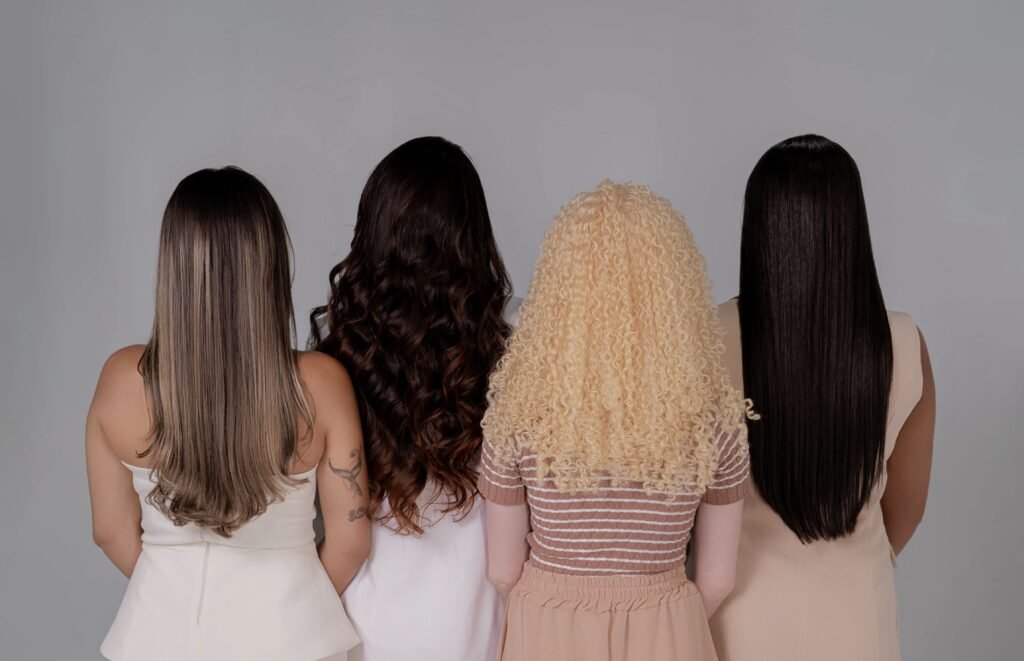
The simplest way to remember the difference is to focus on the goal rather than the marketing name.
Keratin is commonly associated with smoother, more manageable, less frizzy hair. It can be an appealing option for someone who wants to reduce daily styling effort while achieving a polished finish.
Smoothening is generally more focused on changing the appearance and manageability of the hair toward a straighter, controlled result. The exact degree of straightening depends on the system and application.
Hair Botox is generally positioned as a conditioning and cosmetic treatment that aims to improve softness, shine, smoothness, and manageability without necessarily creating the same straightening effect as a stronger smoothing service.
The “right” treatment therefore depends on your hair, your desired result, your previous chemical history, and the exact product being used. A good salon consultation should feel less like choosing something from a menu and more like getting a personalized hair assessment.
Conclusion
Choosing between keratin vs smoothening vs hair Botox becomes much easier when you stop asking, “Which treatment is best?” and start asking, “What does my hair actually need, and what result do I want?”
If you mainly struggle with frizz and difficult styling, keratin may be a treatment category worth discussing. If your dream is a noticeably straighter and more controlled appearance, smoothening may be more aligned with that goal. If your hair looks dry, dull, rough, or cosmetically damaged and you want a softer, shinier appearance while maintaining more natural movement, hair Botox may be worth considering.
The most important step is the consultation. Your stylist should evaluate your hair’s current condition, ask about previous chemical services, understand your desired result, explain the product being used, and discuss aftercare. Don’t choose based only on a name, Instagram reel, or dramatic before-and-after photograph.
And remember the safety side of the decision. Some hair-smoothing products can release formaldehyde when heated, so ingredient transparency, ventilation, professional handling, and appropriate precautions matter. The FDA and OSHA both provide guidance on this issue, and their recommendations are especially relevant when evaluating salon smoothing services.
Ultimately, beautiful hair is not about choosing the strongest treatment. It is about choosing a treatment that matches your hair’s condition, your lifestyle, and the look you genuinely want to maintain.
Frequently Asked Questions
1. Is keratin better than smoothening?
Neither treatment is universally better. Keratin is commonly chosen for frizz reduction and manageability, while smoothening is often selected when a straighter, more controlled appearance is desired. The exact result depends on the product formulation and your starting hair condition.
2. Can hair Botox make hair completely straight?
Hair Botox is generally associated more with conditioning, smoothness, shine, and manageability than dramatic straightening. Some formulas can reduce frizz and loosen the appearance of texture, but the final result varies significantly between products and hair types.
3. Which treatment is best for damaged hair?
There is no universal answer. A professional should assess how damaged your hair is before recommending a chemical or heat-based service. A conditioning-focused treatment may improve the cosmetic appearance of dry or porous hair, but it should not be considered a complete reversal of structural damage.
4. Can keratin treatments damage hair?
The answer depends on the formulation, processing technique, heat, frequency of treatment, and condition of the hair. Some smoothing products also raise formaldehyde-exposure concerns when heated. Always ask your salon about the exact product, ingredients, safety precautions, and suitability for your hair.
5. How do I choose between keratin, smoothening, and hair Botox?
Start by identifying your main goal. Choose the conversation around frizz control and manageability if that is your priority, straightness and texture control if that is what you want, or conditioning, softness, and shine if your main concern is the appearance and feel of damaged hair. A professional consultation can then match your goal with the specific product available at the salon.
Current safety sources consulted
The FDA explains that some hair-smoothing products can release formaldehyde when heated and recommends checking ingredients and asking salon professionals about product safety information. OSHA similarly documents formaldehyde exposure concerns associated with certain hair-smoothing products and emphasizes ventilation, training, protective measures, and workplace controls where applicable.