In today’s competitive beauty and wellness industry, customer experience is one of the most important factors determining a salon’s long-term success. Clients no longer visit a salon only for a haircut, hair colour, facial, or beauty treatment. They also expect professional service, personalized recommendations, hygiene, comfort, transparency, and consistent results.
This is where professional salon training makes a significant difference. A well-trained salon team understands how to deliver quality services, communicate effectively with clients, follow hygiene standards, and create an environment where customers feel valued.
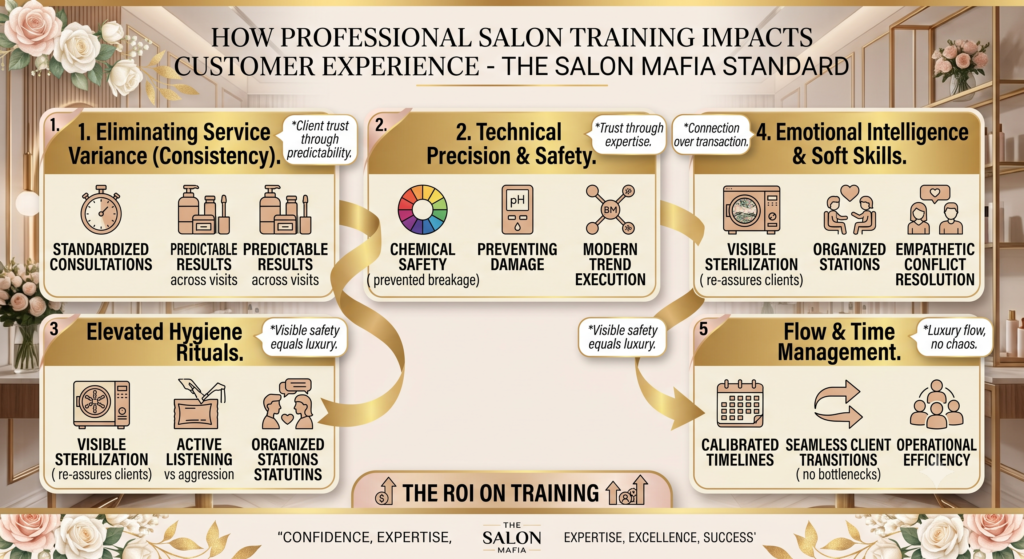
The Salon Mafia recognizes the importance of professional skills, customer satisfaction, and standardized service practices in building a premium salon experience. By focusing on professional development and service quality, salons can strengthen customer relationships, encourage repeat visits, and build a trusted brand identity.
In this article, we will explore how professional salon training impacts customer experience and why investing in skilled salon professionals is essential for sustainable business growth.
1. Understanding the Importance of Professional Salon Training
Professional salon training is the process of developing the technical knowledge, practical skills, and customer service abilities required to work effectively in the beauty industry.
Salon professionals need more than basic knowledge of hair, skin, and beauty treatments. They must understand different client needs, modern techniques, product selection, consultation methods, and professional service standards.
Training may include:
- Haircutting and hairstyling techniques
- Hair colouring, highlights, and chemical treatments
- Facial and skincare procedures
- Makeup and grooming services
- Client consultation and communication
- Hygiene, sanitation, and equipment handling
- Product knowledge and aftercare advice
- Salon etiquette and customer relationship management
When employees receive structured training, they are better prepared to meet customer expectations and deliver services with confidence.
For a premium salon brand like The Salon Mafia, professional training also helps establish consistent service standards across different employees and locations.
2. Improving the Quality of Salon Services

Service quality is one of the first things customers notice when visiting a salon. A technically skilled professional can understand the requested style, assess the client’s hair or skin condition, and select suitable techniques.
For example, a client requesting a hair colour transformation may need advice about their existing hair colour, hair condition, maintenance requirements, and expected results.
A trained stylist can explain the available options before starting the service. This helps the client make an informed decision and reduces the risk of misunderstandings.
Professional training improves service quality by helping salon staff:
- Perform services using appropriate techniques.
- Understand different hair and skin types.
- Select suitable products for specific requirements.
- Follow established service procedures.
- Reduce avoidable errors.
- Maintain consistent results.
When customers receive services that meet their expectations, they are more likely to trust the salon and return for future appointments.
3. Creating a Better First Impression
The customer experience begins before the actual beauty service starts. The way a customer is welcomed, guided, and assisted can influence their overall impression of the salon.
Receptionists, salon managers, hairstylists, and beauty professionals all contribute to this experience.
Professional training helps employees understand how to greet customers politely, manage appointments, explain service options, and respond to questions.
A positive first impression includes:
- A warm and professional welcome.
- Clear communication about appointments and waiting times.
- Assistance in selecting suitable services.
- A clean and organized reception area.
- Respectful and courteous behaviour.
- Transparent information about pricing.
For The Salon Mafia, these details can help create a premium experience in which customers feel comfortable from the moment they enter the salon.
4. Strengthening Client Consultation and Communication
Effective communication is essential for understanding customer expectations.
Sometimes, clients cannot clearly explain the hairstyle, haircut, colour, or beauty treatment they want. In other cases, their expectations may not match what is realistically achievable.
A trained professional knows how to ask the right questions, listen carefully, and explain suitable options.
For example, before performing a chemical hair treatment, a stylist should discuss the client’s hair history, current condition, desired results, and maintenance needs.
A proper consultation should cover:
- The client’s expectations and preferences.
- Relevant hair or skin concerns.
- Suitable services and alternatives.
- Estimated cost and service duration.
- Potential limitations and maintenance requirements.
- Recommended aftercare.
This approach encourages informed decisions and helps prevent dissatisfaction caused by unrealistic expectations.
When customers feel heard and understood, they are more likely to develop confidence in the salon professional.
5. Maintaining Hygiene and Safety Standards

Cleanliness is a fundamental part of customer experience. Customers expect salon tools, workstations, treatment areas, towels, and equipment to be maintained appropriately.
Professional training teaches salon employees how to follow hygiene and sanitation procedures relevant to their services.
Important practices include:
- Cleaning and disinfecting reusable tools according to applicable guidelines.
- Using clean towels and appropriate protective materials.
- Washing or sanitizing hands when required.
- Maintaining clean workstations between clients.
- Following product instructions and safety precautions.
- Checking relevant allergies, sensitivities, and contraindications before treatments.
- Storing salon products and chemicals safely.
Training is especially important when employees perform chemical hair treatments, waxing, facials, and other services that require specific precautions.
Consistent hygiene practices help customers feel more comfortable and demonstrate that the salon takes their well-being seriously.
6. Building Customer Trust and Confidence
Customer trust develops when a salon consistently delivers professional service and communicates honestly.
Clients want to know that their chosen professional understands the service, recommends appropriate options, and respects their preferences.
Training supports trust by teaching salon employees to explain procedures, discuss realistic results, disclose costs, and provide appropriate aftercare advice.
For instance, if a client requests a particular hair colour that may require multiple sessions, a trained stylist can explain the process rather than promising an unrealistic outcome.
Similarly, beauty professionals should recommend products based on the client’s needs instead of pressuring them to make unnecessary purchases.
For The Salon Mafia, a trust-based service approach can help establish stronger customer relationships and encourage positive word-of-mouth recommendations.
7. Personalizing the Customer Experience

Every customer has different preferences, budgets, lifestyles, and beauty goals. A personalized experience helps clients feel that the service has been selected specifically for them.
Professional training enables salon staff to understand individual requirements and adapt their recommendations accordingly.
Personalization can include:
- Suggesting haircuts that suit the client’s preferences and styling routine.
- Recommending haircare products according to hair condition.
- Discussing skincare services based on individual needs and suitability.
- Offering maintenance advice after colour or chemical treatments.
- Considering the client’s available time and budget.
- Recording service preferences with appropriate consent.
Personalized recommendations should always be based on professional judgment, client preferences, and suitable service practices.
When customers receive relevant advice rather than generic recommendations, their salon visit can feel more valuable and comfortable.
8. Improving the Overall Salon Environment
Customer experience involves more than the final service result. The atmosphere, employee behaviour, waiting time, and organization of the salon also influence customer satisfaction.
Professional training helps employees understand their responsibilities and work together more effectively.
A trained team can contribute to:
- Better appointment management.
- Reduced confusion between employees.
- Organized service areas.
- Clear communication about delays.
- More efficient coordination between receptionists and stylists.
- A calm and respectful salon environment.
For example, when a salon team communicates effectively about appointments and service duration, customers are less likely to experience unnecessary confusion or frustration.
An organized environment supports a smoother experience and helps the salon maintain professional standards throughout the customer journey.
9. Reducing Customer Complaints and Service Errors
Customer complaints may arise from inconsistent results, poor communication, unexpected charges, long waiting times, or misunderstandings about a service.
Although training cannot eliminate every problem, it can help employees identify common risks and handle situations more professionally.
Training should teach staff how to:
- Confirm the service requested before starting.
- Explain pricing and additional charges in advance.
- Follow the correct service procedure.
- Communicate delays honestly.
- Respond calmly to customer concerns.
- Escalate complex complaints to the salon manager.
- Document feedback and use it to improve future services.
When a customer is dissatisfied, listening carefully and offering an appropriate solution can help protect the relationship.
The goal is not simply to avoid complaints. It is to create a system in which feedback helps improve the salon’s service quality.
10. Increasing Customer Satisfaction and Repeat Visits
Customer retention is important for salon businesses because repeat clients can contribute to more predictable appointment demand and long-term relationships.
Professional training supports retention by helping employees deliver reliable services and create positive experiences.
A satisfied customer may return for regular haircuts, hair treatments, colouring, facials, grooming, or other services.
However, repeat visits depend on several factors, including service quality, pricing, convenience, personal preferences, and the customer’s overall experience.
Salons can use training to strengthen the areas they can control.
For The Salon Mafia, useful practices include maintaining service standards, encouraging appropriate follow-up, listening to customer feedback, and helping clients understand how to maintain their results between visits.
11. Developing Stronger Product Knowledge
Customers often rely on salon professionals for advice about shampoos, conditioners, hair masks, styling products, skincare products, and treatment maintenance.
Without sufficient product knowledge, employees may struggle to explain the differences between products or recommend suitable options.
Professional training helps staff understand:
- Product purpose and intended use.
- Appropriate application techniques.
- Relevant ingredients and product limitations.
- Instructions and safety precautions.
- Compatibility with particular services.
- Home-care routines following salon treatments.
For example, after a colour service, a stylist can explain how suitable home-care products and maintenance routines may help the client manage their hair between appointments.
Recommendations should be honest, relevant, and consistent with the manufacturer’s instructions.
This makes the consultation more useful and helps customers make informed choices.
12. Enhancing the Skills of Hair and Beauty Professionals
The beauty industry continues to introduce new styles, products, equipment, and service techniques. Salon professionals need opportunities to update their knowledge and practical abilities.
Ongoing training helps employees stay familiar with relevant developments while reinforcing essential skills.
Professional development may involve:
- Practical demonstrations.
- Supervised hands-on sessions.
- Workshops on new techniques.
- Product education.
- Customer service exercises.
- Refresher training on hygiene procedures.
- Assessments of technical skills.
A salon that supports continuous learning can identify skill gaps and provide targeted guidance.
For The Salon Mafia, ongoing development can help employees maintain consistent standards while adapting to changing customer preferences.
13. Improving Teamwork and Salon Efficiency
A salon depends on coordination between reception staff, hairstylists, beauty professionals, assistants, and management.
When employees understand their responsibilities and follow consistent procedures, daily operations can become more organized.
Training can improve teamwork by clarifying how staff should communicate about appointments, client requirements, service preparation, and customer concerns.
For example, reception staff may need to communicate a client’s booking details accurately to the relevant stylist. The stylist, in turn, should confirm the service and discuss any changes with the client before proceeding.
Effective teamwork can help reduce scheduling errors, improve service flow, and create a more seamless experience for customers.
14. The Role of Customer Service Training
Technical skills are essential, but they are only one part of a successful salon experience. Employees must also understand how to interact with customers professionally.
Customer service training should address the complete customer journey, from booking an appointment to leaving the salon.
Key areas include:
- Professional greetings and polite communication.
- Active listening.
- Respect for customer preferences.
- Appropriate handling of sensitive feedback.
- Clear explanations of services and prices.
- Professional behaviour during treatments.
- Respect for customer privacy.
- Follow-up communication where appropriate.
A technically skilled stylist who communicates poorly may still leave a customer dissatisfied. Similarly, excellent hospitality cannot fully compensate for poor technical results.
Combining technical expertise with customer service training helps salons deliver a more complete experience.
15. How The Salon Mafia Can Benefit from Professional Training

For a premium salon brand such as The Salon Mafia, training can be an important part of maintaining a recognizable service identity.
Customers visiting different branches of a salon brand generally expect comparable professionalism, service standards, and communication.
A structured training system can help establish that consistency.
Key benefits for The Salon Mafia
Consistent service delivery: Standard operating procedures and practical training help employees follow common service expectations.
Stronger customer relationships: Communication and consultation skills help staff understand individual client requirements.
Professional brand image: Well-trained employees contribute to a polished and organized salon environment.
Improved employee confidence: Practical experience and constructive feedback help professionals perform their responsibilities more confidently.
Better service recovery: Employees who understand complaint-handling procedures can respond to concerns more effectively.
Support for business expansion: Documented training systems can help communicate service expectations when a salon opens additional locations.
These benefits depend on how effectively training is implemented, monitored, and updated.
16. How to Build an Effective Salon Training Program
An effective training program should be practical, measurable, and relevant to the services a salon offers.
Salon owners and managers can follow a structured approach.
Step 1: Identify skill gaps
Assess employees’ existing technical abilities, customer service skills, product knowledge, and understanding of hygiene procedures.
Step 2: Establish service standards
Create clear guidelines for consultations, service delivery, pricing communication, sanitation, and aftercare.
Step 3: Provide practical training
Combine demonstrations with supervised practice so employees can apply what they learn.
Step 4: Train employees in customer communication
Use realistic scenarios to help employees practise consultations, service explanations, and complaint handling.
Step 5: Evaluate performance
Assess technical procedures, customer feedback, adherence to service standards, and employee development needs.
Step 6: Provide ongoing coaching
Offer regular feedback and refresher sessions rather than treating training as a one-time activity.
Step 7: Monitor customer experience
Review satisfaction surveys, repeat bookings, complaint patterns, and appointment management to identify opportunities for improvement.
This approach helps salon management connect employee development with measurable service outcomes.
17. Measuring the Impact of Salon Training on Customer Experience
Salon owners should evaluate whether training is improving actual customer experiences rather than relying only on course attendance.
Useful performance indicators include:
| Performance indicator | What it helps measure |
|---|---|
| Customer satisfaction ratings | How clients evaluate their salon experience |
| Repeat booking rate | Whether customers return for additional services |
| Customer complaints | Recurring service problems and communication gaps |
| Appointment waiting time | Efficiency of scheduling and service coordination |
| Service correction rate | Frequency of services requiring corrective work |
| Customer feedback | Specific strengths and areas for improvement |
| Employee skill assessments | Progress in technical and professional abilities |
These indicators should be reviewed over time and interpreted in context. For example, repeat bookings may also be affected by location, pricing, availability, and customer lifestyle.
Combining customer feedback with employee assessments gives salon management a more complete picture of training effectiveness.
18. Common Salon Training Mistakes to Avoid
Even when a salon invests in training, certain mistakes can limit its effectiveness.
Focusing only on technical skills: Employees also need communication, hygiene, consultation, and complaint-handling skills.
Providing training without practical assessment: Watching a demonstration does not necessarily mean an employee can perform the service correctly.
Ignoring customer feedback: Complaints and suggestions can reveal training needs that management may otherwise overlook.
Using inconsistent procedures: Different employees following different standards can create an uneven customer experience.
Treating training as a one-time activity: Skills and service expectations need periodic review.
Making unrealistic promises: Training should encourage honest communication about achievable results, service duration, and maintenance.
Avoiding these mistakes can help salons develop a more effective learning culture.
19. The Future of Salon Training and Customer Experience
The salon industry continues to evolve as customer expectations, beauty trends, and technology change.
Future training programs may increasingly combine practical workshops with digital learning, video demonstrations, appointment-management systems, and structured customer feedback.
Digital tools can help salons organize learning materials and track employee progress. However, hands-on practice and direct feedback remain important for developing practical beauty skills.
Personalized customer service is also likely to remain an important consideration. Clients value recommendations that reflect their preferences, requirements, and budgets.
For The Salon Mafia, keeping training relevant to customer needs can help the brand maintain service consistency while adapting to new industry developments.
The central principle remains straightforward: professional development should translate into better service, clearer communication, and a more satisfying customer journey.
20. Conclusion: Professional Training Creates Better Salon Experiences
Professional salon training plays an important role in shaping customer experience. It strengthens technical skills, improves communication, supports hygiene standards, and helps salon employees understand what customers expect from a professional beauty service.
When training is combined with clear procedures, ongoing coaching, and customer feedback, salons can create a more consistent and welcoming environment.
For The Salon Mafia, investing in employee development can support its commitment to professional service, premium presentation, and customer satisfaction. The focus should be on ensuring that every customer receives attentive consultation, transparent information, appropriate services, and professional care.
Ultimately, a great salon experience is created by the combination of skilled professionals, thoughtful service, consistent standards, and genuine attention to customers.
Frequently Asked Questions (FAQs)
1. How does professional salon training improve customer experience?
Professional training helps salon employees improve their technical skills, communicate clearly, follow hygiene procedures, and provide services that better match customer expectations.
2. Why is customer service training important in a salon?
Customer service training helps employees manage consultations, explain services and prices, handle feedback professionally, and create a welcoming environment.
3. How often should salon employees receive training?
Training should take place during onboarding and continue through periodic workshops, practical assessments, refresher sessions, and coaching based on performance and customer feedback.
4. Can salon training increase customer retention?
Training can contribute to customer retention by improving service consistency, communication, and satisfaction. However, retention also depends on pricing, convenience, service availability, and individual preferences.
5. What skills should a professional salon employee have?
A professional salon employee should have relevant technical skills, product knowledge, consultation abilities, hygiene awareness, time-management skills, and strong customer service skills.
6. How does training benefit The Salon Mafia?
A structured training program can help The Salon Mafia maintain service standards, develop employee capabilities, improve customer interactions, and support consistent experiences as the business grows.
7. Does professional salon training improve business growth?
Training can support business growth by helping salons improve service quality and customer relationships. Its commercial impact should be assessed using customer feedback, repeat bookings, operating performance, and other relevant business indicators.