
Why Choosing the Right Hair Colour Matters
Hair colour can completely change the way your overall appearance looks. The right shade can brighten your complexion, enhance your eyes, add dimension to your hairstyle, and give you a fresh, confident appearance.
However, choosing a hair colour isn’t simply about picking a shade you like from a picture. The same colour can look very different on two people because of differences in skin tone, undertone, natural hair colour, eye colour, and hair texture.
That’s why using a practical hair colour guide before making a major change can save you from an unwanted result.
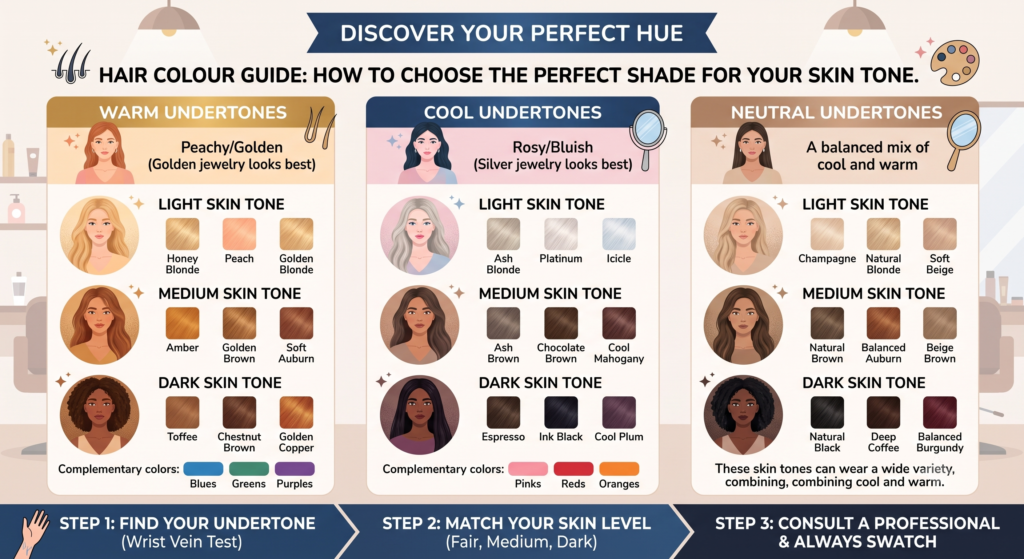
For example, warm shades such as caramel, honey, golden brown, and copper often complement warm undertones beautifully. On the other hand, ash brown, cool chocolate, burgundy, and plum can work especially well with cooler undertones.
But there’s no hard-and-fast rule. Hair colour is also about personal style.
If you want a subtle change, you could choose soft highlights or balayage. If you’re ready for a dramatic transformation, you might consider a global colour, vivid fashion shade, or a combination of highlights and lowlights.
Why professional advice can help
Hair colour involves more than applying colour to the hair. A professional colourist considers:
- Your existing hair colour
- Previous chemical treatments
- Hair porosity
- Hair condition
- Skin undertone
- Desired result
- Colour maintenance
- Appropriate developer and formulation
- Possible colour correction requirements
This is particularly important if you’re moving from dark hair to a much lighter shade.
A professional can also perform a strand test when necessary and recommend a realistic colour journey rather than promising an unrealistic one-session transformation.
Understanding Your Skin Tone and Undertone
Before choosing a shade, you need to understand your complexion.
Your skin tone describes how light or deep your skin appears. Your undertone is the subtle colour underneath your skin. Undertones are generally classified as warm, cool, or neutral.
Understanding both makes choosing a flattering hair colour much easier.
Skin Tone vs. Skin Undertone
These two terms are often confused, but they’re different.
| Skin Tone | Common Description |
|---|---|
| Fair | Very light complexion |
| Light | Light complexion with slightly more depth |
| Medium | Medium or wheatish complexion |
| Tan | Deeper golden or brown complexion |
| Deep | Rich brown to deep complexion |
Your undertone can be:
Warm: Golden, yellow, peach, or olive tendencies.
Cool: Pink, red, bluish, or rosy tendencies.
Neutral: A balance between warm and cool characteristics.
Your skin tone can change with sun exposure, but your natural undertone generally remains more consistent.
How to Find Your Undertone
You don’t need complicated equipment.
Try these simple methods:
1. Check your veins
Look at the veins on your wrist in natural light.
- Greenish veins may indicate warm undertones.
- Bluish or purple veins may indicate cool undertones.
- A mixture may suggest neutral undertones.
2. Try gold and silver jewellery
If gold jewellery tends to complement your complexion more naturally, you may have warm undertones.
If silver looks particularly flattering, you may have cool undertones.
If both look good, you may have neutral undertones.
3. Observe how your skin reacts to sunlight
People with warm undertones may develop a golden or bronze appearance in the sun, while cool undertones may burn or develop a pinker appearance.
Of course, this isn’t a perfect scientific test. Your personal colouring and genetics can make these indicators less obvious.
The Best Hair Colours for Warm Skin Tones

Warm undertones generally pair beautifully with warm or balanced hair colours.
Popular choices include:
- Golden brown
- Caramel
- Honey brown
- Chocolate brown
- Warm chestnut
- Copper
- Auburn
- Golden blonde
- Cinnamon brown
These shades can create a harmonious appearance because their warmth complements the golden, peach, or olive qualities of the skin.
Brown and Caramel Shades
Brown is one of the easiest colours to customise.
If you want something understated, try warm chocolate brown.
For more dimension, caramel highlights can be added around the face or throughout the lengths.
Honey brown can also create a softer, brighter effect without looking overly dramatic.
For Indian hair, warm brown and caramel tones can be especially versatile because they create visible dimension against naturally dark hair.
Red and Copper Shades
If you want something bolder, copper and auburn are worth considering.
Copper can add warmth and personality to your look, while auburn provides a deeper, more sophisticated finish.
However, red and copper shades may require regular maintenance because warm pigments can change as the colour fades.
A professional colourist can help select the right intensity based on your complexion and starting hair colour.
The Best Hair Colours for Cool Skin Tones
Cool undertones often work well with colours that have ash, blue, violet, or neutral characteristics.
Popular choices include:
- Ash brown
- Cool chocolate
- Espresso
- Ash blonde
- Beige blonde
- Mushroom brown
- Burgundy
- Plum
- Cool black
The goal isn’t necessarily to choose an extremely cool shade. Instead, the colour should balance your complexion.
Ash Brown and Blonde Shades
Ash brown is a great option when you want a modern, sophisticated appearance without going extremely light.
For a lighter transformation, ash blonde or beige blonde may work well, depending on your natural hair colour and overall complexion.
Keep in mind that achieving lighter shades from naturally dark hair may require lightening first. This can involve multiple sessions, especially if your hair has previous colour or chemical treatments.
Burgundy and Plum Shades
Want something eye-catching?
Burgundy and plum can be fantastic choices.
These shades offer depth while adding visible colour in sunlight and indoor lighting.
They’re particularly useful if you want a bold colour without moving into extremely bright fashion colours.
The Best Hair Colours for Neutral Skin Tones
If you have neutral undertones, you’ve got plenty of flexibility.
Neutral skin can often work with both warm and cool shades.
Consider:
- Neutral brown
- Chocolate brown
- Espresso
- Beige blonde
- Soft caramel
- Chestnut
- Burgundy
- Rose brown
- Bronde
The trick is choosing the intensity and finish that suits your personal style.
For a natural look, neutral brown or chocolate can be ideal.
For a dimensional appearance, try balayage with caramel or beige tones.
For something more dramatic, burgundy or a rich plum shade can create a striking transformation.
10 Powerful Tips for Choosing Your Perfect Hair Colour
Now let’s get into the practical part of this hair colour guide.
1. Consider Your Natural Hair Colour
Your starting shade has a major impact on the final result.
Dark brown or black hair may need lightening before certain blonde, copper, or pastel shades can be achieved.
If you want minimal maintenance, staying within a few levels of your natural colour is usually easier.
2. Think About Your Eye Colour
Hair colour doesn’t exist in isolation.
Your eyes can influence which shades appear most harmonious.
For example:
- Brown eyes can pair beautifully with chocolate, caramel, chestnut, and burgundy.
- Hazel eyes can look striking with warm brown and copper tones.
- Green eyes can be enhanced by auburn and warm brown shades.
- Blue eyes can complement ash, beige, and cool brown shades.
These aren’t strict rules. Think of them as starting points.
3. Match Colour to Your Lifestyle
Be honest about how much maintenance you’re willing to do.
If you don’t want frequent salon visits, choose a low-maintenance colour.
Balayage and subtle highlights can allow the roots to grow out more naturally.
Global blonde or vivid fashion colours may require more regular appointments.
4. Consider Your Hair Condition
Healthy-looking hair should always be the priority.
If your hair is already extremely dry, brittle, or damaged, aggressive lightening may not be the best immediate option.
A professional can assess the condition of your hair and suggest a suitable treatment plan before colouring.
5. Don’t Choose a Shade Only From a Photo
A picture can be useful for inspiration, but don’t expect an identical result.
The final colour depends on your existing pigment, hair history, texture, porosity, and formulation.
Instead of saying only, “I want this exact colour,” show your colourist the picture and discuss what can realistically be achieved.
6. Think About Your Root Growth
A dramatic contrast between your natural roots and coloured lengths can mean more frequent touch-ups.
If low maintenance matters to you, consider:
- Balayage
- Root melt
- Shadow root
- Face-framing highlights
- Subtle global colour
7. Consider the Season
You don’t have to follow seasonal rules, but they can inspire your choice.
Summer can be a fun time for brighter caramel, honey, or lighter highlights.
Autumn and winter can inspire deeper chocolate, burgundy, espresso, and plum shades.
8. Consider Your Haircut
Your haircut can influence how colour appears.
Layers can showcase highlights beautifully.
Blunt cuts can make global colour appear richer and more uniform.
Face-framing colour can draw attention toward your facial features.
9. Ask About Colour Maintenance
Before choosing a colour, ask:
- How often will I need a touch-up?
- Will I need toner?
- What shampoo should I use?
- Will the colour fade quickly?
- Do I need regular treatments?
- How difficult will it be to return to my natural colour?
These questions can prevent surprises later.
10. Get a Professional Consultation
If you’re unsure, professional consultation is often the safest approach.
A trained colourist can evaluate your current hair and recommend a shade based on your complexion, hair condition, previous colour, and desired outcome.
Hair Colour Ideas for Indian Skin Tones
Indian skin tones vary widely, so there isn’t one universal “best” hair colour.
Your undertone matters more than simply describing your complexion as fair, wheatish, or dusky.
Hair Colours for Fair Indian Skin
Depending on undertone, suitable choices may include:
- Chocolate brown
- Caramel
- Honey brown
- Beige blonde
- Ash brown
- Burgundy
- Soft copper
For a natural transformation, try subtle highlights instead of colouring the entire head.
Hair Colours for Wheatish and Medium Skin
Medium Indian skin tones can work beautifully with:
- Mocha brown
- Chocolate brown
- Caramel
- Chestnut
- Burgundy
- Copper brown
- Golden brown
- Ash brown
Balayage is particularly useful because the colour can be customised to create contrast without overpowering the complexion.
Hair Colours for Dusky and Deep Skin
Rich, dimensional shades can look stunning on deeper complexions.
Consider:
- Espresso
- Dark chocolate
- Burgundy
- Plum
- Deep auburn
- Copper brown
- Warm chestnut
- Mahogany
Instead of focusing only on how “light” a colour is, think about depth, tone, and contrast.
Hair Colour Techniques to Consider
Choosing the shade is only half the story.
The technique used to apply the colour can dramatically change the final appearance.
Balayage
Balayage creates a graduated, hand-painted effect.
It’s ideal if you want:
- Natural-looking dimension
- Softer regrowth
- Face-framing brightness
- A low-maintenance colour effect
Because the colour doesn’t necessarily begin directly at the roots, regrowth can look softer.
Highlights
Highlights add lighter sections throughout the hair.
You can choose:
- Fine highlights
- Chunky highlights
- Face-framing highlights
- Partial highlights
- Full highlights
The size and placement of highlights can be customised according to your haircut and desired result.
Global Hair Colour
Global colour means colouring the hair more uniformly from roots through lengths.
It’s a good choice when you want a clear overall transformation.
Popular global shades include:
- Chocolate brown
- Burgundy
- Black
- Copper
- Auburn
- Espresso
Because root regrowth is more visible with some global colours, maintenance should be considered before making the change.
How to Maintain Coloured Hair
Once you’ve achieved your ideal shade, maintaining it is crucial.
Coloured hair can become dry or lose vibrancy if it’s exposed to excessive heat, harsh cleansing products, chlorine, and frequent washing.
Follow these simple habits:
Use Colour-Safe Products
Choose shampoo and conditioner designed for colour-treated hair.
Avoid unnecessarily harsh cleansing products that may cause colour to fade faster.
Reduce Excessive Heat
Frequent use of straighteners, curling irons, and high-heat blow-drying can make coloured hair look dry.
Use heat protection before styling.
Don’t Overwash
Washing your hair too frequently can contribute to faster colour fading.
Your ideal washing schedule depends on your scalp, hair type, lifestyle, and styling routine.
Use Regular Conditioning Treatments
Coloured hair often benefits from regular conditioning and professional hair treatments.
If your hair has been lightened, your stylist may recommend a suitable repair or conditioning routine.
Protect Hair From the Sun
Strong UV exposure can affect colour vibrancy and hair quality.
When spending extended periods outdoors, consider protective hair products or physical protection such as a hat.
Common Hair Colour Mistakes to Avoid
Even a beautiful colour can become disappointing if the process isn’t planned properly.
Avoid these common mistakes:
Choosing colour without considering undertone: A shade may look fantastic in a photo but not complement your natural colouring.
Ignoring previous colour: Previously coloured hair can behave differently from virgin hair.
Expecting dark hair to become blonde instantly: Major lightening often requires multiple carefully managed steps.
Skipping consultation: A consultation helps establish realistic expectations.
Ignoring aftercare: Poor maintenance can cause colour to fade faster.
Using random home mixtures: Professional colour products require correct formulation and application.
Over-processing hair: Repeated chemical services without sufficient care can affect hair strength and condition.
Professional Hair Colour vs. DIY Hair Colour
DIY colour can appear convenient, especially when you’re making a small change.
However, professional colouring offers greater control over formulation, placement, application, and correction.
| Professional Hair Colour | DIY Hair Colour |
|---|---|
| Custom shade selection | Pre-selected shades |
| Professional assessment | Limited hair assessment |
| Custom application | Usually uniform application |
| Better control over highlights | Limited placement options |
| Colour correction expertise | Correction can be difficult |
| Suitable for complex transformations | Better for simple changes |
If you’re covering a few grey hairs or making a small change close to your existing shade, home colour may sometimes be suitable.
But if you’re considering bleaching, balayage, colour correction, highlights, vivid colour, or a major transformation, professional help is generally the better route.
For additional information about hair and beauty services, you can also explore professional guidance from American Academy of Dermatology.
Frequently Asked Questions
1. How do I choose the best hair colour for my skin tone?
Start by identifying your skin undertone as warm, cool, or neutral. Then select shades that complement it. Warm undertones often suit caramel, golden brown, copper, and warm chocolate, while cool undertones can work well with ash brown, cool chocolate, burgundy, and plum. Neutral undertones offer greater flexibility.
2. What hair colour looks best on Indian skin tones?
There isn’t one colour that suits everyone with Indian skin. Chocolate brown, caramel, burgundy, espresso, chestnut, copper brown, and mahogany can all work well depending on your undertone and personal style.
3. Is balayage better than global hair colour?
Neither is universally better. Balayage is often preferred for natural-looking dimension and softer regrowth, while global colour creates a more uniform transformation. The best choice depends on your desired appearance and maintenance preferences.
4. Can I colour damaged hair?
It depends on the level of damage and the type of colour service. Strong lightening services may not be suitable for severely damaged hair. A professional assessment can help determine whether your hair is ready for colouring.
5. How often should coloured hair be touched up?
It depends on the colour and technique. Global colour may require more frequent root touch-ups, while balayage can often be maintained for longer because of its softer regrowth.
6. Which hair colour requires the least maintenance?
Colours close to your natural hair colour and techniques such as balayage, subtle highlights, and root melts are generally easier to maintain than high-contrast global colours.
7. Should I choose warm or cool hair colour?
Look at your undertone first. Warm undertones often complement warm shades, while cool undertones often work well with cooler shades. If you’re neutral, you have more freedom to experiment.
8. Can hair colour make my face look brighter?
Yes. The right shade and placement can create contrast around the face and make your complexion appear more vibrant. Face-framing highlights are one popular way to achieve this effect.
9. Can I go from black hair to blonde in one appointment?
Sometimes, but not always. Naturally dark or previously coloured hair may require multiple lightening sessions to reach a healthy blonde result. Your hair’s condition should determine the pace of the transformation.
10. Is professional hair colouring worth it?
For complex colour changes, highlights, balayage, bleaching, colour correction, and customised shades, professional colouring can provide better control and help protect the condition of your hair.
Conclusion
Choosing the right hair colour doesn’t have to feel like a guessing game.
The best approach is to consider your skin tone, undertone, natural hair colour, eye colour, lifestyle, haircut, and hair condition before deciding on a shade.
Use this hair colour guide as your starting point, but remember that there are no absolute rules. Your perfect colour should complement your features while also making you feel confident.
If you’re looking for a subtle change, start with chocolate brown, caramel highlights, or a soft balayage. If you want something more noticeable, consider burgundy, copper, auburn, or a customised blonde.
And when you’re planning a major transformation, don’t rush it. A professional consultation can help you choose a realistic colour, understand the maintenance involved, and create a result that’s beautiful and healthy-looking.
The right hair colour isn’t simply the trendiest shade—it’s the shade that works beautifully with you.