
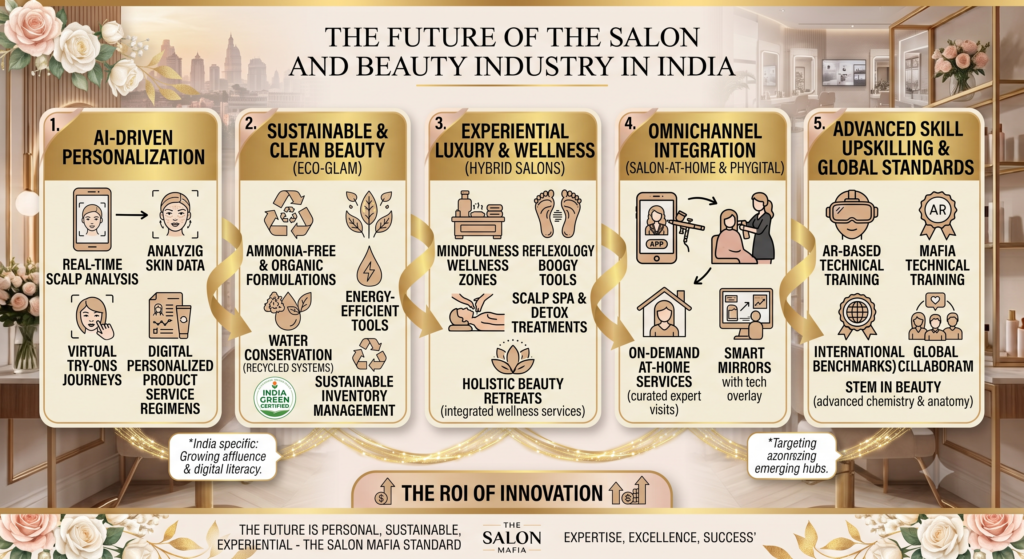
Introduction to India’s Growing Beauty Industry
India’s salon and beauty industry is changing rapidly as customers increasingly view grooming, skincare, hairstyling, and personal care as part of their regular lifestyle rather than occasional luxuries. From traditional neighbourhood salons to premium unisex salons and specialised beauty studios, businesses are adapting to customers who expect professional services, personalised recommendations, hygienic environments, and convenient booking experiences. Beauty services are also becoming more diverse, covering everything from hair colouring and advanced hair treatments to bridal makeup, skin treatments, nail art, and men’s grooming. This evolution is creating opportunities for trained professionals, independent salon owners, beauty educators, product suppliers, and entrepreneurs interested in building businesses in the personal care sector.
The future of the Indian salon industry will depend on more than attractive interiors or fashionable services. Businesses will need skilled employees, reliable service standards, effective digital marketing, customer retention strategies, and a clear understanding of their local markets. Customers can compare salons online, read reviews, view portfolios on social media, and discover new services before deciding where to spend their money. As a result, a salon’s reputation increasingly depends on the complete customer experience, from the first online enquiry to the final service and follow-up communication. For emerging brands such as The Salon Mafia, this changing environment presents an opportunity to build a professional identity around quality, transparency, modern salon experiences, and structured business operations.
1. Key Trends Shaping the Future of Salons
The next phase of the Indian beauty industry will be shaped by changing lifestyles, digital discovery, demand for specialised services, and a growing emphasis on customer experience. Customers are becoming more informed about haircare products, skincare ingredients, styling techniques, and professional treatments. They often arrive at a salon with reference photographs, online recommendations, or questions about which service suits their needs. Salon professionals must therefore combine technical expertise with consultation skills, product knowledge, and the ability to explain realistic results. Businesses that understand these expectations can develop more relevant service menus and create stronger relationships with their customers.
Another important trend is the movement towards specialised services and clearly defined salon identities. Some salons focus on premium hair transformations, while others build their reputation around bridal makeup, skin services, men’s grooming, or complete family grooming. This specialisation helps businesses communicate their expertise to a specific audience rather than trying to compete on every service at once. At the same time, customers increasingly appreciate salons that offer a consistent experience across appointments, including transparent pricing, dependable service quality, and professional communication. The future is likely to reward businesses that understand their customers and continually improve their offerings instead of relying only on discounts or expensive interiors.
1.1. Premium Salon Experiences and Personalisation
Personalisation is becoming an important part of the modern salon experience. Customers want services that reflect their hair texture, face shape, skin concerns, lifestyle, budget, and personal preferences. A professional consultation allows the stylist or beauty therapist to understand these needs before recommending a treatment. For example, a customer considering hair colouring may need advice about maintenance, suitable shades, previous chemical treatments, and the condition of their hair. A salon that explains these factors clearly can help customers make informed decisions and establish realistic expectations.
Premium service does not necessarily mean charging the highest prices in the market. It means delivering value through expertise, attention to detail, comfort, and reliable results. A welcoming reception, clean workstations, properly maintained equipment, clear service explanations, and respectful staff interactions all contribute to the experience. Salons can also personalise services by maintaining appointment histories, recording product preferences with consent, and sending relevant aftercare guidance. These practices help transform a one-time visitor into a regular customer. For The Salon Mafia, building a premium identity can involve making every stage of the customer journey feel professional, transparent, and thoughtfully managed.
1.2. Technology and Digital Transformation
Technology is changing how salons attract customers, organise appointments, manage staff, and measure business performance. Social media platforms allow stylists to display their work, demonstrate techniques, introduce new services, and communicate directly with potential customers. Google Business Profile can help nearby customers discover a salon, check its location, view photographs, read reviews, and contact the business. Online appointment systems and messaging tools can reduce booking friction, while digital billing and customer-management software can help owners understand revenue patterns and repeat visits.
The next stage of digital transformation will involve using customer information and business data more intelligently. Salon owners can review which services generate the most bookings, identify quieter periods, monitor repeat-customer rates, and plan promotions around actual demand. Automated appointment reminders may help reduce missed appointments, while digital feedback forms can reveal problems that might otherwise go unnoticed. However, technology should support personal service rather than replace it. Customers still value human conversation, skilled hands, and individual attention. Salons should also protect customer contact details, obtain appropriate consent for promotional messages and photographs, and avoid making misleading claims in advertisements. When technology and human expertise work together, salons can become more organised without losing their personal touch.
2. The Growth of India’s Salon and Beauty Market

The Indian salon industry is part of a broader beauty and personal care economy that continues to evolve. According to Ken Research, its August 2026 market report estimates that India’s beauty salon market was valued at approximately US$12.565 billion in 2025 and could reach US$19.773 billion by 2031, representing a projected compound annual growth rate of 7.85%. These figures are market estimates rather than guaranteed outcomes, but they indicate the scale of the opportunity being considered by salon operators and investors.
Demand is supported by regular haircare, skincare, men’s grooming, bridal services, and customers seeking more specialised treatments. The market also includes a wide range of businesses, from independent neighbourhood salons to professionally managed chains and franchise outlets.
An important distinction is that the wider beauty and personal care market includes retail products, while the salon market focuses on services. The two areas influence one another, but their growth figures should not be treated as interchangeable. For salon owners, the practical opportunity lies in understanding which services customers in their own area purchase regularly and which specialised services they are willing to book occasionally. A salon in a residential neighbourhood might build dependable revenue through haircuts, hair colouring, facials, and grooming packages, while a premium studio in a commercial district may focus more heavily on advanced hair treatments and personalised consultations. Business success depends on matching the service offering to local demand, managing operating costs, and encouraging repeat visits rather than relying solely on industry-wide growth projections.
3. The Rise of Professional Beauty Education
Professional education will play a central role in the future of the salon industry because customer expectations are increasing alongside the complexity of available services. A modern stylist may need to understand haircutting techniques, colour theory, hair texture, scalp care, chemical treatments, product compatibility, and consultation methods. Beauty therapists also need practical knowledge of sanitation, skin assessment, product handling, and the limitations of the treatments they offer. These skills cannot be developed through social media tutorials alone. Practical training, supervised experience, feedback from experienced instructors, and continued learning help professionals build the confidence needed to deliver consistent services.
Beauty academies can also help address a business challenge: finding and retaining skilled employees. Salon owners need professionals who can perform services correctly while communicating with customers, managing appointments, and following hygiene procedures. Training programmes that combine technical practice with customer service and workplace readiness can help students prepare for real salon environments. For aspiring professionals, recognised qualifications and a strong practical portfolio may improve employment opportunities, although outcomes depend on the quality of the training and local demand. For salon businesses, investing in staff development can improve service consistency and reduce the disruption caused by frequent employee turnover.
The future of beauty education will also involve specialisation and ongoing upskilling. Professionals may pursue advanced courses in hair colouring, bridal makeup, nail technology, skin services, or salon management as their careers develop. Digital learning can support theory and demonstrations, while hands-on practice remains essential for developing technical ability. Salon brands that establish structured training systems may be better positioned to maintain common service standards across multiple locations. In this environment, education is not simply a way to enter the beauty industry; it becomes a continuing investment in professional growth, customer satisfaction, and long-term business development.
4. Salon Franchises and Business Opportunities
Salon franchising is one business model through which entrepreneurs can enter the beauty industry using an established brand and operating framework. Instead of building every process independently, a franchise partner may receive access to brand guidelines, salon design support, staff training, service protocols, marketing resources, and operational guidance. The exact support depends on the franchise agreement, so prospective investors should review what is actually included before making a financial commitment. Franchising can reduce the need to develop every business system from scratch, but it does not eliminate the risks associated with location selection, staffing, customer acquisition, competition, and cash flow.
The expansion of organised salon networks illustrates why this model attracts attention. Established brands can standardise training, marketing, procurement, and customer experience while local partners manage day-to-day operations. Market research also identifies expansion beyond major metropolitan areas as an area of interest for salon businesses.
Smaller cities may offer opportunities where customers want professional services but have fewer organised options nearby. However, demand varies considerably between locations. Entrepreneurs should study the area’s population, spending patterns, commercial rents, existing competitors, accessibility, and likely repeat-customer base before deciding whether to open a salon.
4.1. Why Entrepreneurs Are Exploring Salon Franchises
For a first-time entrepreneur, launching a salon can involve numerous decisions: choosing the business name, developing the service menu, designing the interior, purchasing equipment, recruiting staff, setting prices, and attracting customers. A franchise may provide a structured starting point and access to an existing business format. It may also offer launch campaigns, staff education, operating manuals, and ongoing brand support. These resources can help an entrepreneur understand the practical requirements of running a salon, although their usefulness depends on the franchisor’s capabilities and the franchisee’s own management.
Before investing, entrepreneurs should prepare a realistic financial plan. The initial budget may include franchise fees, interiors, equipment, deposits, licences, opening inventory, recruitment, and launch marketing. Monthly expenses may include rent, salaries, utilities, consumables, software, royalties, and advertising contributions. A salon can attract strong initial interest and still struggle if its recurring revenue does not cover these expenses. Investors should request a detailed breakdown of costs, clarify contractual obligations, speak with existing franchisees where possible, and assess different revenue scenarios. A franchise should be evaluated as a business investment, not as a promise of guaranteed profit.
4.2. The Role of Brands Like The Salon Mafia
Emerging brands such as The Salon Mafia can participate in the industry’s evolution by developing a clear service identity and a structured salon experience. A premium salon concept can focus on professional consultations, contemporary interiors, skilled stylists, transparent pricing, hygiene, and consistent customer care. These elements help establish expectations before customers even enter the salon. A brand that communicates its services clearly online and delivers the same standard in person has more opportunities to earn positive reviews, repeat visits, and referrals.
For a growing salon brand, the challenge is to turn a compelling identity into a repeatable business model. That means documenting service procedures, setting staff-training requirements, defining quality standards, monitoring customer feedback, and providing franchise partners with practical operating support where franchising is offered. Marketing should communicate real services and genuine customer experiences rather than relying on exaggerated promises. The Salon Mafia can use digital portfolios, local search visibility, informative beauty content, and consistent brand presentation to reach relevant audiences. Over time, sustainable growth will depend on whether the brand can maintain service quality and sound business practices as its customer base or outlet network expands.
5. Consumer Behaviour and Emerging Markets
Indian beauty consumers are not one uniform group. Their preferences differ according to age, income, location, lifestyle, cultural occasions, and personal grooming habits. Younger customers may discover hairstyles and beauty treatments through short-form videos and creator recommendations, while working professionals may prioritise convenience and predictable appointment times. Bridal customers often seek detailed consultations, trial services, and coordinated packages, whereas regular salon visitors may focus on affordable maintenance. Understanding these differences helps salon owners design services and communication that are relevant to the people they want to serve.
Demand is also changing outside the largest cities. Industry coverage from the India Brand Equity Foundation describes how grooming has increasingly become part of everyday routines, with social media helping beauty trends reach younger consumers in smaller cities as well as major urban centres.
This creates opportunities for salons that can combine professional service standards with locally appropriate pricing. A business in a developing city may not need an elaborate luxury format to succeed; it may benefit more from a clean, modern environment, trained staff, accessible services, and reliable customer relationships.
Men’s grooming is another area salon owners can consider. Haircuts, beard styling, facials, scalp-care services, and grooming packages can help businesses serve customers who prefer professional maintenance. At the same time, women’s haircare, bridal services, skincare, and occasion-led packages remain relevant parts of many salon menus. Rather than following every trend, owners should use customer enquiries, booking patterns, and sales data to identify which services merit investment. A carefully chosen service mix can help a salon serve its target market without tying up too much money in equipment, inventory, or training for services that attract little demand.
6. Sustainability, Hygiene, and Customer Trust
Hygiene and customer trust are fundamental to a salon’s long-term reputation. Customers expect clean workstations, properly sanitised reusable tools, fresh towels, safe product handling, and appropriate precautions during treatments. Salon owners should establish clear cleaning schedules, train employees in sanitation procedures, maintain equipment, and follow applicable local rules. These practices are especially important for services involving skin contact, chemical products, waxing, or tools used on multiple customers. Good hygiene should be part of daily operations rather than something introduced only during inspections or promotional campaigns.
Sustainability is also becoming relevant as customers and businesses pay more attention to waste, packaging, water use, and energy consumption. Salons can examine practical measures such as responsible product dispensing, reducing unnecessary single-use materials where safe, separating waste appropriately, and maintaining equipment to avoid wasteful consumption. Product choices should be based on suitability, safety, performance, and reliable information rather than unsupported claims that something is completely natural or harmless. Sustainability measures should also be financially sensible so that they can become lasting operating habits instead of short-lived marketing campaigns.
Transparency connects hygiene and sustainability with customer loyalty. Before a treatment, professionals should explain the process, expected results, aftercare, relevant risks, and total cost. If a service may not be suitable for a customer’s hair or skin, staff should communicate that clearly and recommend an appropriate alternative. Salons should obtain permission before publishing customer photographs and handle personal information responsibly. These actions demonstrate respect for the customer and help establish a reputation based on honesty. In a competitive market, trust can encourage repeat visits just as effectively as attractive offers or stylish interiors.
7. Challenges and Opportunities for Salon Owners
Although the industry’s growth prospects create opportunities, salon owners still face substantial operational challenges. Rent, salaries, product costs, utilities, equipment maintenance, and marketing can put pressure on margins. Competition may come from neighbourhood salons, premium chains, home-based professionals, and at-home service platforms. Skilled staff may also move between businesses, making recruitment and retention ongoing concerns. A salon therefore needs more than strong technical services; it needs a clear financial plan, efficient scheduling, effective staff management, and a reason for customers to return.
One of the most common mistakes is setting prices by copying competitors without understanding actual costs. A service that appears popular may generate limited profit if it takes too long, uses expensive products, or requires extensive rework. Owners should understand the cost of delivering each service and monitor average customer spending, repeat bookings, staff productivity, and monthly cash flow. They should also distinguish revenue from profit: a busy salon is not necessarily a profitable one. Regular financial reviews can reveal whether a promotion is bringing valuable repeat customers or merely reducing revenue per appointment.
Digital competition creates both challenges and opportunities. Customers can compare prices and reviews quickly, which makes service quality and online reputation more visible. Salons can respond by maintaining accurate business listings, publishing authentic work, answering enquiries promptly, and responding professionally to customer feedback. Promotions can attract new visitors, but they should support a wider retention strategy involving consultation quality, service consistency, and follow-up care. Businesses that measure the results of their marketing can direct spending towards channels that generate actual bookings rather than focusing only on views and followers.
8. How to Prepare for the Future of the Beauty Industry
Salon owners and aspiring entrepreneurs can prepare for the industry’s future by building strong fundamentals before investing heavily in expansion. Start with market research: identify the target customer, map competing salons, understand local price ranges, and determine which services are in demand. Then develop a business plan covering setup costs, monthly expenses, staffing, pricing, marketing, and working capital. For a franchise, add a careful review of the agreement, support commitments, renewal terms, territory provisions, and ongoing fees. Financial projections should include conservative scenarios in which customer acquisition takes longer than expected.
The next priority is creating a consistent customer experience. Establish consultation procedures, service standards, hygiene routines, appointment policies, and complaint-handling processes. Train employees to communicate clearly and recommend services responsibly. Use a booking or customer-management system that suits the salon’s size, and track a small set of meaningful indicators, including repeat visits, appointment cancellations, average spending, customer feedback, and service-level profitability. These measurements help owners identify problems early and make decisions based on evidence rather than assumptions.
Finally, treat learning and innovation as ongoing activities. Follow developments in haircare, skincare, styling, customer service, and salon technology, but test new services carefully before introducing them widely. Gather feedback from customers and employees, review the results, and adjust the service menu accordingly. Build a recognisable brand through consistent communication and reliable delivery. For businesses such as The Salon Mafia, expansion should follow a proven operating model rather than come at the expense of quality. The future belongs to businesses that can combine professional expertise, customer trust, operational discipline, and a willingness to adapt.
9. Conclusion
The future of the salon and beauty industry in India offers meaningful opportunities for trained professionals, independent salon owners, beauty academies, and franchise entrepreneurs. Market research points towards continued growth, while changing consumer habits are increasing the importance of personalisation, digital discovery, specialised services, and dependable customer experiences. These developments create room for both affordable neighbourhood salons and premium brands, provided they understand their audiences and manage their businesses carefully.
However, industry growth alone cannot guarantee success for any individual salon. Sustainable performance requires skilled employees, hygienic practices, realistic pricing, sound financial management, effective marketing, and customer relationships built on trust. Entrepreneurs exploring a franchise should investigate the business model and its costs before investing, while established operators should focus on improving service consistency and customer retention. Brands such as The Salon Mafia can build their place in the market by translating a premium identity into professional everyday experiences. The future of India’s salon industry will be shaped not simply by how many salons open, but by how well they serve their customers and run their businesses.
10. Frequently Asked Questions (FAQs)
FAQ 1: What is the future of the salon industry in India?
The outlook indicates continued growth, supported by regular grooming needs, rising interest in specialised beauty services, digital discovery, and the expansion of organised salon businesses. Ken Research projects that the Indian beauty salon market could grow from US$12.565 billion in 2025 to US$19.773 billion by 2031. These are estimates, not guaranteed results, and individual business performance will depend on location, competition, costs, and service quality.
FAQ 2: Is opening a salon in India a good business opportunity?
Opening a salon can be a business opportunity for entrepreneurs who identify local demand and develop a realistic financial plan. Success depends on factors such as the location, target audience, service menu, employee skills, operating costs, pricing, and ability to retain customers. Research the market and calculate your expected break-even point before investing.
FAQ 3: Will salon franchises grow in India?
Salon franchises may continue to expand as brands seek to standardise services and reach more cities. A franchise can provide brand recognition, training, marketing resources, and operating procedures, depending on the agreement. Prospective franchisees should independently verify the franchisor’s claims, speak with existing partners, and understand all fees and contractual obligations before signing.
FAQ 4: Which salon services may see growing demand in the future?
Hair colouring, specialised hair treatments, skincare, bridal makeup, men’s grooming, nail services, and personalised grooming packages are areas salon owners may explore. Demand varies by city, customer profile, and price point. Businesses should use local customer enquiries and booking data to decide which services to introduce.
FAQ 5: How can The Salon Mafia prepare for the future of the beauty industry?
The Salon Mafia can prepare by maintaining consistent service standards, investing in staff training, strengthening its online presence, communicating prices transparently, and prioritising hygiene and customer satisfaction. If the brand expands through franchising, documented operating procedures and ongoing partner support can help maintain consistency. Long-term growth should be supported by measurable customer demand and sound financial management.