
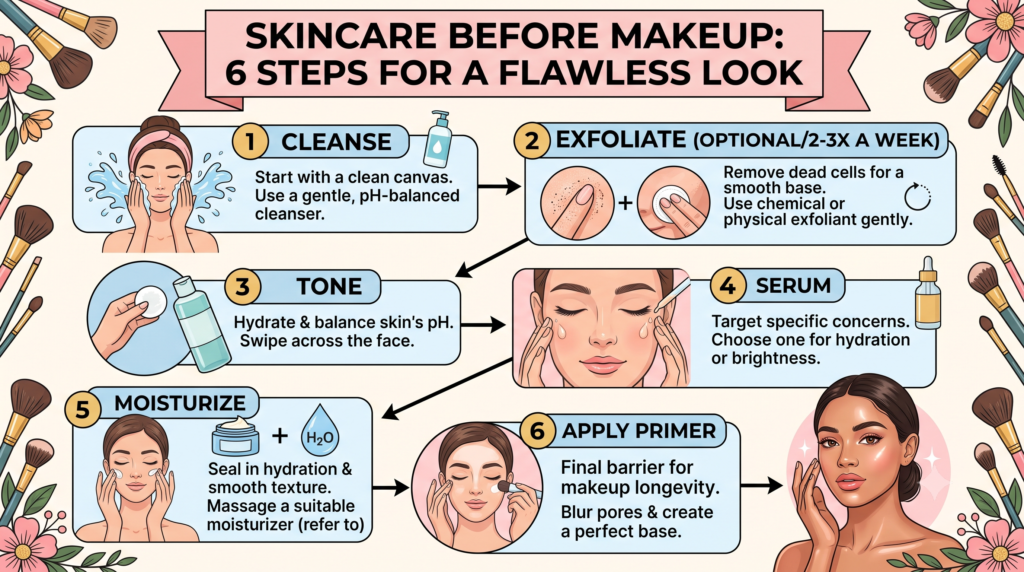
Skincare Before Makeup: 11 Powerful Steps for a Flawless Look
Makeup can transform your appearance, but the real secret to a smooth and radiant finish starts before you pick up your foundation brush. Good skincare before makeup helps create a clean, hydrated, and comfortable base while allowing makeup to sit more evenly on the skin.
Whether you’re getting ready for work, a casual outing, a party, or a special event, a few thoughtful skincare steps can make a noticeable difference. You don’t need a complicated routine, either. The key is choosing products that suit your skin type and applying them in the right order.
In this guide, we’ll explore 11 powerful steps for a flawless look, explain why each step matters, and share practical tips for preparing different skin types for makeup.
1. Understand Your Skin Type
Before building your routine, understand what your skin actually needs. Skincare products aren’t one-size-fits-all. A moisturizer that feels comfortable on dry skin may feel too rich for oily skin, while an aggressive cleanser may leave sensitive skin uncomfortable.
The main skin types are generally:
- Dry skin: Often feels tight, rough, or flaky.
- Oily skin: Produces excess sebum and may look shiny.
- Combination skin: Usually has oilier areas, especially around the T-zone, with drier areas elsewhere.
- Normal skin: Generally feels balanced and comfortable.
- Sensitive skin: May react easily to certain products or environmental factors.
Your skin can also change with weather, age, stress, lifestyle, and hormonal fluctuations. So, don’t feel that you have to follow exactly the same routine every day.
Why Skin Type Matters Before Makeup
The wrong skincare routine can affect how makeup looks. For example, insufficient hydration may make foundation emphasize dry patches. On the other hand, using too many heavy products can contribute to a greasy-looking makeup base.
A simple approach works well:
Cleanse → Treat → Hydrate → Protect → Prime
The products within those steps should be selected according to your individual skin needs.
2. Cleanse Your Skin Thoroughly
Cleansing is one of the most important parts of skincare before makeup. Your face can collect sweat, oil, dust, and residue from previous skincare products. Applying makeup directly over that buildup can make your base look uneven.
Choose a gentle cleanser that doesn’t leave your skin feeling excessively tight after washing.
How to Cleanse Before Makeup
- Wash your hands first.
- Wet your face with lukewarm water.
- Apply a suitable cleanser.
- Massage gently without aggressive rubbing.
- Rinse thoroughly.
- Pat your face dry with a clean towel.
Avoid very hot water because it can be uncomfortable and may contribute to dryness.
If you’re preparing your skin in the morning, cleansing should generally be simple. Your goal isn’t to make your skin feel “squeaky clean.” Instead, you want it clean and comfortable.
3. Exfoliate, But Don’t Overdo It
Exfoliation can help remove dead skin cells from the skin’s surface. When used appropriately, it can leave skin feeling smoother and help makeup apply more evenly.
However, more exfoliation doesn’t mean better results.
Over-exfoliating can cause dryness, irritation, redness, or sensitivity. That’s particularly important when you’re planning to wear makeup shortly afterward.
Physical vs. Chemical Exfoliation
| Type | General Characteristics |
|---|---|
| Physical exfoliation | Uses particles or tools to manually remove surface buildup |
| Chemical exfoliation | Uses ingredients designed to loosen dead skin cells |
| Gentle exfoliation | Usually focuses on maintaining skin comfort rather than aggressive removal |
If your skin is sensitive or you’re unfamiliar with exfoliating acids, consider speaking with a qualified dermatologist or skincare professional before introducing strong products.
For an important event, don’t experiment with a new exfoliating product immediately before makeup. Your skin deserves a little predictability.
4. Apply a Suitable Toner
Toner is an optional step, but it can be useful depending on your skincare routine and product choice.
Modern toners can serve different purposes. Some provide hydration, while others contain ingredients designed for specific skin concerns.
If your skin tends to be dry, a hydrating toner may help add another layer of lightweight moisture. If your skin is sensitive, choose a simple formula and avoid unnecessary fragrance or potentially irritating ingredients.
How to Use Toner
After cleansing:
- Apply toner according to the product instructions.
- Avoid rubbing aggressively.
- Allow it to absorb naturally.
- Follow with your treatment or moisturizer.
Remember that toner isn’t mandatory. A good skincare routine doesn’t need to contain every product available on a beauty shelf.
5. Add Targeted Skincare
This is where your routine can become more personalized.
Depending on your needs, you may use a serum or another targeted treatment before moisturizer. Common skincare ingredients include vitamin C, niacinamide, hyaluronic acid, and other active ingredients.
However, don’t layer multiple powerful actives simply because they are popular.
Keep Your Pre-Makeup Routine Simple
For daytime makeup preparation, lightweight products often work well. Your goal is to create a comfortable surface rather than build multiple thick layers.
For example:
Cleanser → Hydrating serum → Moisturizer → Sunscreen → Primer
If you’re already using prescription skincare or strong active ingredients, follow your dermatologist’s instructions rather than changing your routine solely for makeup.
For evidence-based general information about skin care, you can also refer to the American Academy of Dermatology.
6. Moisturize for a Smooth Base
Moisturizer is one of the most useful steps in skincare before makeup.
Hydrated skin generally provides a more comfortable surface for makeup application. If your skin is dry, foundation can sometimes catch on flaky areas and make texture more noticeable.
Choose Moisturizer According to Your Skin
Dry skin:
Look for richer, moisturizing formulas that help support the skin barrier.
Oily skin:
A lightweight, non-comedogenic moisturizer may feel more comfortable.
Combination skin:
Use a balanced formula and adjust the amount across different areas if needed.
Sensitive skin:
Keep ingredients simple and choose products you’ve already used successfully.
Don’t Apply Too Much
More moisturizer isn’t automatically better. Applying an excessive amount can leave your skin overly slippery and may cause makeup to move around.
Use an appropriate amount, massage gently, and allow it to settle.
7. Never Skip Daytime Sun Protection
If you’re doing your makeup during the daytime, sunscreen is an important part of your skincare routine.
Broad-spectrum sunscreen helps protect skin from ultraviolet radiation. The American Academy of Dermatology recommends broad-spectrum, water-resistant sunscreen with SPF 30 or higher for exposed skin.
Sunscreen Before Makeup
The usual order is:
Skincare → Sunscreen → Makeup
Apply sunscreen evenly to exposed areas and give it time to settle before applying makeup.
Some makeup products contain SPF, but relying only on makeup may not provide the same coverage as properly applied sunscreen.
If you’re attending an outdoor event, remember that sunscreen isn’t a one-and-done step. Reapplication may be necessary depending on your exposure, sweating, swimming, and the sunscreen’s instructions.
8. Give Special Attention to the Eye Area
The skin around your eyes can have different needs from the rest of your face.
If the area feels dry, a suitable eye-area moisturizer may help your concealer apply more comfortably. However, don’t overload the area with multiple products immediately before makeup.
Before Applying Concealer
Try this simple approach:
- Cleanse gently.
- Apply a suitable lightweight moisturizer.
- Allow it to absorb.
- Apply a small amount of concealer.
- Blend without pulling or rubbing the skin.
If you experience persistent irritation around the eyes, stop using products that appear to trigger it and consider professional medical advice.
9. Don’t Forget Your Lips
A flawless makeup look isn’t only about your complexion.
Dry, flaky lips can make lipstick appear uneven. That’s why simple lip care should also be part of your preparation.
Apply a comfortable lip balm while completing your skincare routine. This gives it some time to soften the lips before lipstick application.
Lip Prep Tips
- Use a moisturizing lip balm.
- Avoid aggressively scrubbing dry lips.
- Don’t repeatedly lick your lips.
- Give balm time to absorb.
- Blot excess balm before applying lipstick if necessary.
For long-wear lipstick, you can adjust your lip preparation according to the formula you’re using.
10. Apply Primer Strategically
Primer isn’t always essential, but it can help create the type of finish you’re looking for.
Different primers are designed for different purposes:
| Primer Type | Common Purpose |
|---|---|
| Hydrating primer | Adds a comfortable, moisturized feel |
| Mattifying primer | Helps reduce the appearance of excess shine |
| Smoothing primer | Creates a smoother-looking makeup surface |
| Illuminating primer | Adds a luminous appearance |
| Pore-blurring primer | Helps soften the visible appearance of pores |
You don’t necessarily need to apply primer everywhere.
For example, if your T-zone becomes shiny but your cheeks feel dry, you might use a mattifying product only where needed and a hydrating approach elsewhere.
Less Is Often More
One of the most common makeup-prep mistakes is applying too many layers.
If your skincare, sunscreen, and primer are all thick, makeup may struggle to adhere properly. Keep each layer lightweight whenever possible.
11. Let Your Skincare Settle
Here’s a small step that can make a big difference: don’t rush immediately from skincare to foundation.
Give your products enough time to settle according to their formulas and your skin’s needs.
If you apply foundation while your skincare is still very wet or slippery, you may find that makeup moves around during blending.
A Simple Waiting Strategy
After applying each major layer:
- Let it absorb.
- Check whether your skin feels comfortable.
- Remove any excess product if necessary.
- Then continue to the next step.
You don’t need to sit around for half an hour. The goal is simply to avoid piling products onto skin before the previous layer has settled.
12. Common Skincare Mistakes Before Makeup
Even a good routine can go wrong when products are used incorrectly.
Using Too Many Products
More products mean more opportunities for pilling, irritation, or an uncomfortable makeup base.
Keep your pre-makeup routine focused.
Trying New Products on Event Day
Your wedding, party, birthday, or important work event isn’t the ideal time to test a completely new skincare product.
A new product may cause unexpected dryness, irritation, or breakouts.
Skipping Moisturizer Because You Have Oily Skin
Oily skin still needs hydration. Instead of skipping moisturizer entirely, consider a lightweight formula appropriate for your skin.
Applying Too Much Primer
Primer should support your makeup rather than become another thick layer underneath it.
Forgetting the Neck
If you’re applying makeup beyond your face, consider your neck as part of the overall preparation. Keep product application even and appropriate for your skin.
Aggressive Exfoliation
Scrubbing harder won’t necessarily create smoother skin. Gentle and consistent care is generally more practical than aggressive last-minute treatments.
13. Skincare Before Makeup for Different Skin Types
Your ideal routine depends on your skin’s condition and the makeup finish you’re trying to achieve.
For Dry Skin
Focus on hydration and comfort.
A simple routine may include:
Gentle cleanser → Hydrating serum → Moisturizer → Sunscreen → Hydrating primer
Avoid excessive powder if your skin already looks dry.
For Oily Skin
Focus on lightweight hydration and shine management.
Gentle cleanser → Lightweight serum → Oil-friendly moisturizer → Sunscreen → Mattifying primer
Don’t try to remove every trace of natural oil. The goal is balanced-looking skin.
For Combination Skin
Combination skin often benefits from targeted application.
You could use lightweight hydration across the face while giving extra attention to areas that feel dry.
For Sensitive Skin
Simplicity is particularly useful.
Stick with products your skin already tolerates well. Avoid introducing multiple new active ingredients immediately before an event.
For Normal Skin
You have more flexibility, but that doesn’t mean you need a complicated routine.
A basic cleanse, moisturize, sunscreen, and optional primer routine may be sufficient.
14. Preparing Skin for Weddings and Special Events
Special occasions often require makeup that lasts for several hours.
That doesn’t mean you should overload your skin with products.
Instead, focus on preparation in the days and weeks before the event.
Build a Consistent Routine
Consistency usually matters more than last-minute experimentation.
Maintain:
- Regular cleansing
- Appropriate moisturization
- Daily sun protection
- Suitable exfoliation
- Adequate hydration
- A balanced skincare routine
The Night Before
Avoid aggressive treatments unless they’re already part of your established routine.
Get enough rest, cleanse your skin properly, and moisturize according to your normal routine.
On the Day
Keep your preparation comfortable and predictable.
Your makeup artist can then work with a clean, hydrated, well-prepared surface.
15. Professional Skincare and Makeup Preparation
Professional makeup artists often consider the condition of the skin before choosing products and techniques.
For example, dry areas may need additional hydration, while oily areas may require a different preparation strategy.
A professional may also consider:
- Makeup duration
- Event location
- Weather
- Lighting
- Photography
- Skin texture
- Desired finish
- Makeup formula
- Client comfort
For bridal makeup especially, a consultation can help determine which preparation approach makes sense.
If you’re considering professional beauty services, communicate your usual skincare products and any known sensitivities beforehand.
16. How to Create a Simple Pre-Makeup Routine
If all these steps feel like too much, don’t worry. You don’t need to use every product.
A simple routine can be highly effective.
Everyday Routine
Step 1: Cleanse
Step 2: Moisturize
Step 3: Apply sunscreen during the day
Step 4: Let products settle
Step 5: Apply primer if needed
Step 6: Start makeup
Special Occasion Routine
Step 1: Gentle cleansing
Step 2: Hydrating treatment if suitable
Step 3: Moisturizer
Step 4: Sunscreen for daytime events
Step 5: Targeted primer
Step 6: Makeup application
The best routine is one your skin tolerates and that works with your makeup products.
17. Frequently Asked Questions
What is the correct skincare order before makeup?
A common order is cleanser, treatment or serum, moisturizer, sunscreen during the daytime, and primer before makeup. The exact order can vary depending on the products you’re using.
Is skincare really necessary before makeup?
Yes, appropriate skincare can help create a more comfortable and smoother-looking base. However, your routine doesn’t need to be complicated.
How long should I wait between skincare and makeup?
Allow each layer enough time to settle so the skin isn’t excessively wet or slippery. The exact timing depends on the products and your skin.
Should I moisturize before foundation?
Yes. Moisturizer can help provide hydration and comfort before foundation. Choose the formula according to your skin type and avoid applying excessive amounts.
Can oily skin use moisturizer before makeup?
Absolutely. Oily skin still benefits from hydration. A lightweight moisturizer may be more comfortable for people with oily skin.
Should sunscreen be applied before makeup?
For daytime makeup, sunscreen should generally be applied as part of your skincare routine before makeup. Choose a broad-spectrum sunscreen and follow its application instructions.
Do I need primer after skincare?
Not necessarily. Primer is optional and can be selected based on the makeup finish you’re trying to achieve.
Can I exfoliate immediately before makeup?
It’s generally better not to introduce aggressive or unfamiliar exfoliation immediately before an important makeup application. It may cause irritation or sensitivity.
How can I stop foundation from looking cakey?
Start with appropriate skincare, avoid excessive product layering, allow skincare to settle, and apply foundation in thin layers. Your skin type and foundation formula also matter.
What’s the most important skincare step before makeup?
There isn’t one universal step for everyone. Cleansing, appropriate moisturization, and daytime sun protection are key components of a basic routine, while other steps can be customized.
Conclusion
A flawless makeup look doesn’t begin with foundation—it begins with well-prepared skin.
The right skincare before makeup routine can help your skin feel clean, hydrated, comfortable, and ready for makeup. Start with the basics: understand your skin type, cleanse gently, moisturize appropriately, protect your skin from the sun, and use primer only when it adds value.
Most importantly, don’t chase perfection by piling on products. Keep your routine consistent, choose products your skin tolerates, and give each layer time to settle.
When skincare and makeup work together, you can create a polished look that feels just as good as it looks.