Hair Spa Benefits: Why Your Hair Needs Professional Care – 7 Powerful Reasons
What Is a Professional Hair Spa?
A professional hair spa is a structured hair-care treatment designed to improve the condition, appearance, and manageability of the hair and scalp. Unlike a quick shampoo-and-condition routine, a professional treatment usually combines cleansing, conditioning, massage, and targeted products according to the individual’s hair needs.
The exact treatment can vary from salon to salon. Some services focus on hydration, while others are designed for dry, damaged, frizzy, chemically treated, or dull-looking hair.
One of the biggest hair spa benefits is that the treatment gives your hair more focused care than your everyday routine. Professional stylists can look at your hair texture and condition and recommend products or techniques that make sense for you.
It’s also important to understand what a hair spa can—and can’t—do. A hair spa isn’t a permanent solution for every hair or scalp concern. It primarily helps improve the feel, appearance, moisture balance, and manageability of the hair. If you’re experiencing persistent scalp problems or significant hair loss, professional medical advice may be more appropriate.
The American Academy of Dermatology Association also recommends choosing hair-care practices based on your specific hair type and condition rather than following a one-size-fits-all routine.
Why Does Your Hair Need Professional Care?
Your hair goes through a lot every day.
Sun exposure, pollution, heat styling, frequent washing, colouring, chemical services, hard water, and environmental changes can all affect how your hair looks and feels. Even when your hair appears healthy, it can gradually become dry, rough, tangled, or difficult to style.
Daily shampoo and conditioner are important, but they may not always provide the intensive conditioning your hair needs after repeated styling or chemical treatments.
That’s where professional hair care can make a difference.
A salon professional can assess factors such as:
- Hair texture
- Dryness level
- Frizz
- Split ends
- Previous chemical treatments
- Colour-treated hair
- Scalp condition
- Hair thickness
- Styling habits
- Heat exposure
Based on this assessment, the stylist can select a suitable treatment rather than simply applying the same product to everyone.
Professional care is particularly useful when your hair feels rough or lacks its usual softness and shine. And, let’s be honest, sometimes your hair simply needs more attention than your regular home routine can provide.
7 Powerful Hair Spa Benefits You Should Know
Hair spa treatments have become popular because they combine hair conditioning with a relaxing salon experience. However, the benefits aren’t limited to the feeling of relaxation.
Let’s look at seven major hair spa benefits that explain why professional care can be a useful addition to a hair-care routine.
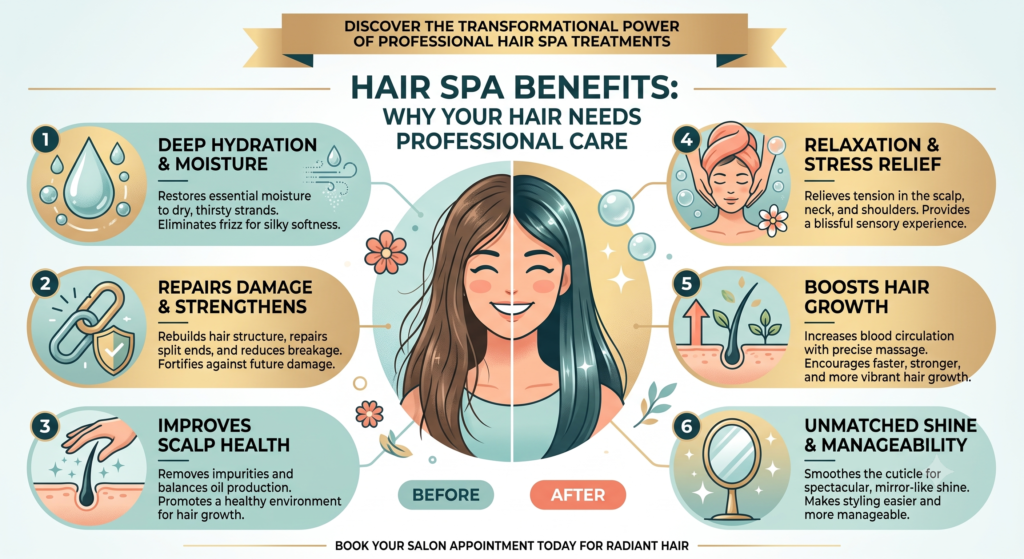
1. Deep Hydration and Moisture
One of the most noticeable benefits of a hair spa is improved moisture and softness.
Dry hair can feel rough, look dull, and become difficult to manage. Factors such as heat styling, colouring, chemical treatments, weather, and frequent washing may contribute to dryness.
A professional conditioning treatment helps coat and condition the hair, making it feel smoother and more comfortable to handle.
Hydration is particularly important for hair that:
- Feels dry after washing
- Looks dull
- Becomes tangled easily
- Has been exposed to frequent heat styling
- Has undergone colouring or chemical treatments
- Feels rough at the ends
However, “hydration” doesn’t mean that a hair spa permanently changes the internal structure of your hair. The improvement is generally cosmetic and conditioning-based, so maintaining the results requires consistent hair care.
2. Improved Hair Texture
Another important hair spa benefit is improved hair texture.
When hair becomes dry or damaged, the surface can feel rough and uneven. This can make brushing and styling more difficult.
A suitable professional treatment can help the hair feel:
- Softer
- Smoother
- Less rough
- Easier to comb
- More manageable
The difference can be especially noticeable after a professional conditioning service because the treatment is applied evenly and allowed to work properly.
If your hair has been exposed to frequent styling, a regular conditioning-focused treatment may help maintain a smoother appearance between salon visits.
3. Reduced Dryness and Frizz
Frizz is one of the most common complaints among people with dry or textured hair.
When hair lacks sufficient conditioning, individual strands can look rough and unruly. Humidity can make the situation even more noticeable.
A hair spa treatment can temporarily improve the smoothness and conditioning of the hair, which may make frizz easier to control.
Still, results depend on your hair type and the cause of the frizz. A hair spa isn’t the same as permanent straightening, smoothening, keratin treatment, or other chemical services.
For naturally curly or wavy hair, the goal shouldn’t necessarily be to remove all texture. Instead, good conditioning can help curls and waves look more defined, soft, and manageable.
4. Better Hair Manageability
Have you ever spent more time brushing your hair than actually styling it?
Tangles, roughness, and dryness can make everyday hair care frustrating. A conditioning treatment can make the strands feel smoother and easier to handle.
Improved manageability can mean:
- Easier detangling
- Less roughness while brushing
- Easier styling
- A smoother finish
- Less time spent fighting with your hair
This is one reason professional hair spa treatments can be useful before important occasions.
However, remember that gentle handling is still important. Pulling aggressively through tangled hair can cause unnecessary breakage, even when the hair has been conditioned.
5. Healthier-Looking Scalp
Hair quality begins with the scalp, and professional hair care often includes a gentle scalp massage.
A scalp massage can feel relaxing and can be a pleasant part of a salon treatment. It also encourages you to pay attention to scalp care rather than focusing only on the visible length of your hair.
However, it’s important to distinguish between a cosmetic hair spa and medical scalp treatment.
If you have persistent itching, severe dandruff, sores, inflammation, or unusual scalp changes, a dermatologist should evaluate the problem. A salon treatment shouldn’t replace medical care.
For a generally healthy scalp, maintaining appropriate cleansing habits and avoiding excessive product buildup can support a comfortable scalp environment.
6. Enhanced Shine and Smoothness
Healthy-looking hair often has a naturally smoother and more reflective appearance.
When the hair surface is properly conditioned, it may look shinier and feel smoother. This can give your hairstyle a polished salon finish.
This is another reason hair spa treatments are popular before:
- Weddings
- Parties
- Festivals
- Photoshoots
- Professional events
- Special celebrations
The key word is appearance. A hair spa can improve how your hair looks and feels, but it doesn’t magically repair every type of structural damage.
For severely damaged hair, your stylist may recommend trimming, reducing chemical services, changing your heat-styling routine, or using a more suitable professional treatment.
7. Relaxation and Self-Care
Not every hair-care benefit needs to be purely cosmetic.
A professional hair spa can also be a relaxing experience. Shampooing, conditioning, scalp massage, and quiet time away from your daily routine can provide a welcome break.
Modern life can be hectic. Taking an hour for yourself can feel like pressing the reset button.
This doesn’t mean a hair spa treats stress or medical conditions. Rather, it’s a personal-care experience that combines grooming with relaxation.
And sometimes, that’s exactly what you need.
Hair Spa vs Regular Hair Conditioning
A common question is: “Why should I get a hair spa when I already use conditioner at home?”
The answer is that both can have a place in your routine, but they’re not necessarily identical.
| Feature | Regular Conditioning | Professional Hair Spa |
|---|---|---|
| Frequency | Often used during washing | Occasional salon treatment |
| Application | Quick home routine | Structured professional service |
| Product selection | Usually self-selected | Can be chosen based on hair needs |
| Massage | Usually absent | Often included |
| Treatment time | Short | Longer and more intensive |
| Personal assessment | Limited | Stylist can assess hair condition |
| Experience | Routine care | Hair care + relaxation |
Think of your regular conditioner as routine maintenance and a professional hair spa as an occasional intensive conditioning experience.
Neither has to replace the other.
What Happens During a Professional Hair Spa?
The exact steps vary by salon and treatment, but a typical professional hair spa may include the following.
1. Hair and Scalp Assessment
The stylist first examines your hair and discusses your concerns.
This is an important step because dry hair, chemically treated hair, curly hair, and oily hair may need different approaches.
2. Cleansing
The hair is cleansed to remove dirt, oil, styling residue, and buildup.
A suitable shampoo is selected according to the hair and scalp condition.
3. Conditioning Treatment
A professional treatment mask or conditioning product is applied to the hair.
The product should generally be distributed properly rather than applied randomly.
4. Scalp Massage
Many hair spa services include a gentle scalp massage.
This can make the treatment more relaxing while helping distribute the product where appropriate.
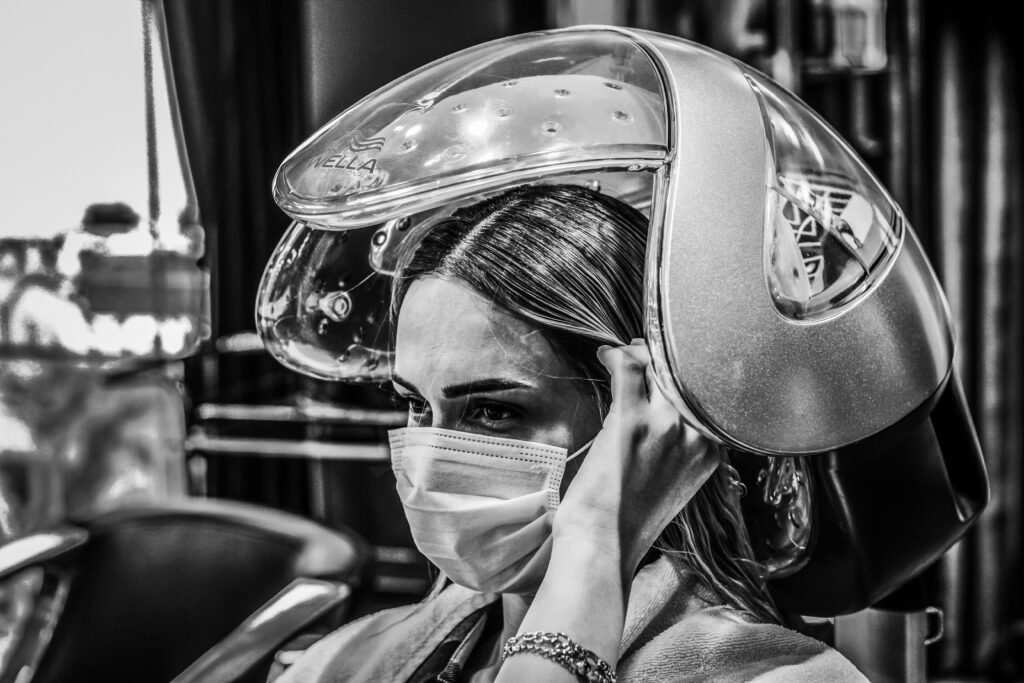
5. Steam and Treatment Absorption
Some salons use controlled steam as part of the service.
The purpose is generally to support the conditioning process and provide a warm, relaxing treatment experience. The technique and duration should be appropriate for the client’s hair and scalp.
6. Rinsing and Finishing
The treatment is rinsed thoroughly, followed by appropriate finishing steps.
Depending on the service, the stylist may blow-dry or style the hair.
The result is typically softer, smoother, shinier, and more manageable-looking hair.
Who Can Benefit From a Hair Spa?
A wide range of people can enjoy professional hair spa treatments.
They may be especially useful for people with:
- Dry or rough hair
- Frizzy hair
- Dull-looking hair
- Tangled hair
- Heat-styled hair
- Colour-treated hair
- Chemically treated hair
- Hair that feels difficult to manage
- Hair exposed to environmental stress
People with naturally curly or wavy hair can also benefit from suitable conditioning treatments.
However, not everyone needs the same treatment.
For example, someone with a very oily scalp may need a different approach from someone with extremely dry hair. That’s why professional consultation matters.
How Often Should You Get a Hair Spa?
There’s no universal schedule that works for everyone.
Your ideal frequency depends on:
- Hair type
- Hair condition
- Chemical treatments
- Heat-styling habits
- Scalp condition
- Lifestyle
- Climate
- Home-care routine
For some people, an occasional treatment every few weeks may be enough. Others with very dry or chemically treated hair may prefer more frequent professional conditioning.
The important thing is not to treat a salon schedule as a strict rule.
Instead, observe how your hair responds.
If your hair feels healthy and manageable, you may not need frequent treatments. If it repeatedly becomes dry, rough, or difficult to manage, discuss a suitable routine with your stylist.
Hair Spa for Different Hair Types
Dry Hair
Dry hair often benefits from moisture-focused conditioning.
Look for treatments designed to improve softness and reduce the rough feeling associated with dryness.
Oily Hair
Oily hair requires balance.
Heavy products applied directly to the scalp may not always be appropriate. Your stylist can recommend a treatment that conditions the lengths without creating unnecessary buildup.
Curly Hair
Curly hair can be prone to dryness because natural oils may not distribute evenly along the length.
A suitable conditioning treatment can help curls feel softer and more manageable.
Straight Hair
Straight hair can still become dry, dull, or frizzy.
A professional treatment may improve smoothness and shine without changing the natural texture.
Colour-Treated Hair
Colour-treated hair requires careful handling.
A stylist should consider the condition of the hair before recommending intensive services. Gentle cleansing and appropriate conditioning can help maintain a polished appearance.
Chemically Treated Hair
Hair that has undergone chemical services may require additional conditioning and careful maintenance.
Your stylist should assess the condition before choosing a treatment.
Common Hair Spa Mistakes to Avoid
Even a good hair spa routine can become less effective if you make common mistakes.
Choosing a Treatment Without Assessment
Don’t simply select a treatment because it worked for someone else.
Your hair may have completely different needs.
Expecting Permanent Results
A hair spa can improve the appearance and feel of your hair, but the results aren’t usually permanent.
Your daily routine still matters.
Ignoring Heat Damage
If you’re using high heat every day, a salon treatment alone won’t solve the underlying issue.
Use appropriate heat protection and avoid unnecessary heat exposure.
Overusing Treatments
More isn’t always better.
Frequent intensive treatments may not be necessary for every hair type. Follow professional advice and observe how your hair responds.
Using the Wrong Products at Home
A professional treatment can be followed by poor home care.
Using unsuitable products, excessive shampooing, or aggressive brushing can quickly affect your results.
Professional Hair Spa vs DIY Treatment
DIY hair masks can be useful for basic conditioning, especially when you’re using a simple routine that suits your hair.
So why choose professional care?
The main difference is expertise and personalization.
A professional stylist can:
- Assess your hair
- Identify visible dryness or damage
- Choose an appropriate treatment
- Apply products correctly
- Control treatment time
- Provide styling advice
- Suggest a home-care routine
DIY treatments can complement professional care, but they shouldn’t be viewed as an automatic replacement.
Be careful with internet trends involving kitchen ingredients, essential oils, or strong acids. Natural doesn’t always mean suitable for every scalp or hair type.
How to Maintain Hair Spa Results at Home
Getting a professional treatment is only one part of the process.
To extend the smooth and conditioned feel, build healthy habits into your routine.
Use a Suitable Shampoo
Choose a shampoo appropriate for your scalp and hair type.
Avoid using excessive amounts.
Condition Regularly
Apply conditioner mainly where your hair needs it, particularly through the lengths and ends.
Limit Excessive Heat
Frequent high-temperature styling can contribute to dryness and damage.
Whenever you use heat, follow the recommendations for your specific styling tool and use a suitable heat-protection production