
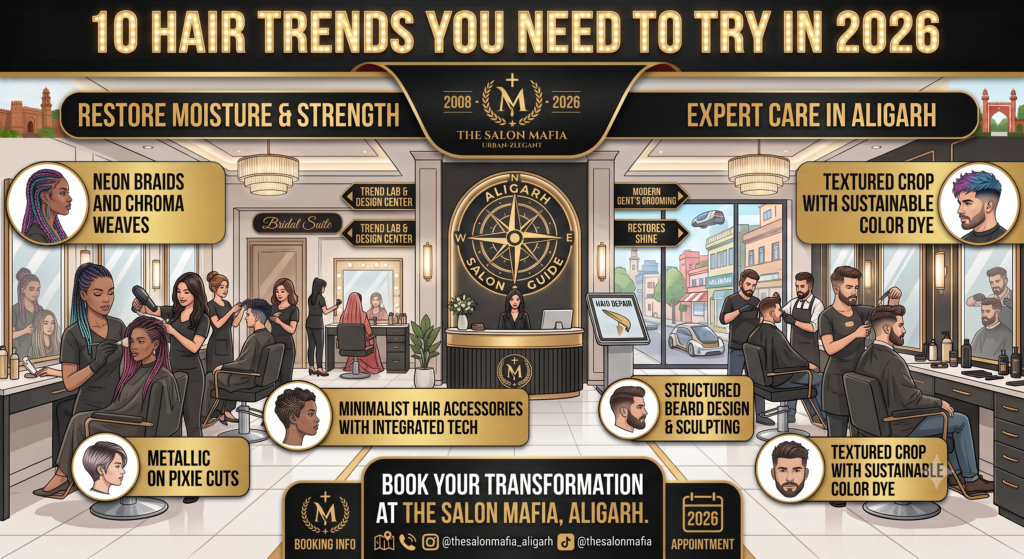
Hair trends in 2026 are moving in an interesting direction. Instead of simply chasing the loudest color or the most dramatic haircut, many of this year’s biggest looks are built around healthy-looking hair, movement, shine, personalization, and wearable glamour. Current trend reporting from Vogue, Allure, and Vogue India shows a mixture of polished 1990s and early-2000s influences, richer brunette shades, softer blondes, expressive fringe, airy layers, and more natural-looking color. Vogue’s September 2026 trend report specifically highlights sleek, glossy finishes, side parts, enhanced natural texture, modern crimping, hair jewelry, rich brunette shades, and softer blonde tones.
That does not mean 2026 hair has become boring. Quite the opposite. There is room for an ultra-short pixie, a dramatic bob, waist-length hair, metallic platinum, deep brunette, playful pink, or a highly textured cut. Allure’s 2026 trend coverage has highlighted both extremes, from dramatic color drenching and metallic platinum to ultra-long lengths and textured pixies. The exciting part is that you don’t have to completely reinvent yourself to participate. A new fringe, a gloss treatment, a few face-framing layers, a richer brunette tone, or a more polished blowout can make your existing hairstyle feel completely different. Think of 2026 as a wardrobe refresh for your hair: you can change the entire outfit, or simply add one accessory that transforms the look.
Why 2026 Hair Trends Feel Different
One of the clearest themes emerging in 2026 is intentional hair. The era of making every strand look artificially perfect is giving way to styles that appear polished while still retaining movement and personality. Celebrity hairstylist George Northwood told Vogue that sleek, healthy-looking and glossy hair is becoming important, but without making the hair appear stiff or overly styled. Irinel De León similarly described a move toward movement, natural texture, and small personalized details. This distinction matters because a good haircut should work with your hair rather than constantly fight against it.
You can see the same philosophy in current color trends. Vogue India’s 2026 color report describes a shift toward warmer, deeper, more relaxed tones, including amber, copper, cherry, richer brunettes, and lived-in blondes. Instead of asking whether a particular celebrity’s hair color will suit you exactly, the better question is how the underlying idea can be adapted to your complexion, natural base, lifestyle, and maintenance routine. Someone who does not want frequent salon visits might choose a soft bronde or lived-in brunette, while someone looking for a major transformation might explore color drenching or metallic platinum.
The Shift Toward Healthy, Glossy Hair
Hair health has become part of the aesthetic itself. Shine, smoothness, softness, and visible movement can make almost any haircut look more expensive and sophisticated. This is particularly noticeable in the return of bouncy blowouts, polished layers, rich brunette shades, and natural-looking blondes. Vogue’s current 2026 coverage repeatedly connects the year’s aesthetic with healthier-looking, glossy hair rather than rigid styling.
That is good news if you want a trend that does not require a dramatic haircut. A professional gloss, appropriate conditioning routine, heat protection, regular trims, and a haircut designed around your natural texture can sometimes produce a bigger visual difference than a complicated color transformation. Before choosing a trend, consider the condition of your hair. If your hair is already fragile from repeated bleaching or chemical services, the smartest transformation may be one that improves its appearance while reducing unnecessary processing. Trendy hair looks great in photographs, but healthy hair makes almost every trend easier to wear.
1. The Modern Bob
The bob remains one of the most adaptable haircut families in 2026. Rather than disappearing after previous seasons of popularity, it is being reshaped through different lengths, textures, and finishing techniques. Current fashion coverage includes graduated bobs, softly sculpted bobs, choppy shapes, and cuts sitting around the jawline or shoulders. Vogue India identifies graduated bobs among the notable 2026 trends, while Allure’s spring coverage points toward softer sculpting and gentle bob shapes.
What makes the modern bob particularly useful is its ability to change personality without changing the basic silhouette. A sharp, sleek bob can look sophisticated and architectural, while a softly textured bob can feel relaxed and youthful. A shoulder-grazing version gives you more styling flexibility, whereas a chin-length bob creates a stronger visual statement. If you have thick hair, internal weight removal can help create movement; if your hair is fine, a cleaner perimeter can make the ends appear fuller. Before booking the appointment, show your stylist several references rather than relying on the word “bob” alone, because the difference between a blunt bob, graduated bob, textured bob, and softly layered bob can be substantial.
Why the Bob Is Back
The renewed interest in shorter shapes is connected to the broader desire for hair that feels intentional without requiring endless styling. A well-designed bob can frame the face, remove damaged ends, and create an instantly recognizable silhouette. It also photographs beautifully, which helps explain why variations of the style continue to appear across celebrity, editorial, and social-media inspiration. Current 2026 haircut reporting continues to feature bobs alongside pixies, layered cuts, and longer styles, suggesting that there is no single dominant length this year.
If you are nervous about going short, start with a long bob or shoulder-grazing midi bob. It gives you a noticeable transformation while preserving enough length for ponytails, waves, and other styling options. For someone who wants a stronger statement, a chin-length or graduated bob can create much more visual impact. The best version is not necessarily the most fashionable one; it is the version that matches your face shape, density, texture, and willingness to style it every morning.
2. Curtain and Cascading Bangs
Bangs are one of the easiest ways to transform a hairstyle without changing its entire length. In 2026, fringe is becoming more expressive, with styles ranging from delicate whisper fringe to curtain bangs, bottleneck bangs, micro bangs, and relaxed bedhead versions. Who What Wear’s September 2026 coverage identifies these variations as notable fall fringe directions and emphasizes how different fringe shapes can personalize the face.
Curtain bangs remain especially versatile because they can be blended into face-framing layers. When cut correctly, they can be worn parted in the center, pushed to the side, or incorporated into a fuller blowout. Bottleneck bangs offer a slightly more structured shape, narrowing toward the center before opening toward the cheekbones. If you want something softer, a wispy fringe can provide movement without creating a heavy visual line. Bangs do require maintenance, though, so talk with your stylist about how frequently you are comfortable trimming them before choosing a shorter version.
Finding the Right Fringe
The best fringe is not selected from a trend board alone. Your hair density, forehead proportions, natural growth pattern, texture, and daily routine all matter. Someone with naturally curly hair may need a very different cutting and styling strategy from someone with fine, straight hair. Likewise, a person who rarely uses heat tools may prefer a low-maintenance curtain shape rather than a highly structured fringe that requires daily blow-drying.
The good news is that fringe can be customized dramatically. A stylist can alter the length, density, angle, and connection between the bangs and the rest of the haircut. That means you can take inspiration from a celebrity or editorial photograph without copying the exact hairstyle. In 2026, the broader direction is toward personalized fringe rather than one universal bang shape, which makes this trend particularly easy to adapt.
3. Rich Brunette and Espresso Hair
If you prefer deeper colors, 2026 is giving brunettes plenty of inspiration. Rich brunette, espresso, coffee mocha, and similarly deep tones are receiving significant attention. Vogue’s September 2026 hair report specifically describes lavish brunette shades as a major direction, with coffee mocha and rich espresso tones providing depth without looking overly warm or icy.
The appeal of deep brunette is simple: it can make hair appear visually richer and more reflective when the color is properly maintained. Instead of relying on obvious highlights, the look often depends on depth, shine, and subtle tonal variation. That makes it particularly attractive for people who want a sophisticated transformation without going dramatically lighter. A professional colorist can also adjust the brunette toward warmer chocolate, neutral mocha, or cooler espresso depending on the starting base and desired result.
One important point is that “brunette” is not a single color. Two people can both have dark brown hair and look completely different because of undertones. If you are considering this trend, discuss whether you want a warm, neutral, or cooler finish and whether you want dimension or a more uniform color. The result should complement your skin tone and existing wardrobe rather than simply reproduce a photograph taken under studio lighting.
4. Soft Golden and Wheat Blonde
Blonde is taking a softer route in 2026. Instead of demanding an extremely bright, high-maintenance finish, one of the notable directions is wheat-like, soft-golden, natural-looking blonde. Vogue’s current 2026 coverage describes this look as softly sun-kissed and created through fine micro-lights rather than obvious highlight lines.
This is a useful trend for anyone who loves blonde but dislikes the constant battle with visible roots. A finely blended blonde can grow out more naturally because the transition between the base and lighter sections is less abrupt. Vogue’s expert coverage also describes organic blonde as a finely woven blend that mimics naturally occurring variations rather than looking like a collection of separate highlighted stripes.
The key is restraint. The most sophisticated version should look dimensional when light hits it, not like several disconnected colors placed beside one another. Depending on your natural base, your colorist may recommend baby lights, micro-weaves, glossing, or a softer blonde-brown transition. Remember that going significantly lighter can still require substantial maintenance, so the condition of the hair should remain part of the conversation.
5. Bronde Blends
Bronde, the meeting point between brown and blonde, continues to be a practical 2026 choice for people who want dimension without committing fully to either extreme. Vogue India has specifically highlighted bronde blends in 2026, describing them as a modern option for Indian skin tones.
Bronde is appealing because it can be customized almost endlessly. You can keep a deeper natural root and gradually introduce caramel, beige, honey, or neutral blonde through the mid-lengths and ends. The contrast can be subtle or pronounced depending on how dramatic you want the transformation to be. For someone moving from dark hair toward blonde, a bronde approach can also provide an intermediate stage that feels intentional rather than like an unfinished transition.
This trend is particularly useful if your lifestyle does not allow frequent salon appointments. A well-blended transition can remain visually attractive as the natural root grows. Of course, the maintenance schedule depends on the technique, starting color, and amount of lightening involved, but the general concept is built around softness rather than harsh contrast. If you are unsure whether to choose brown or blonde, bronde gives you permission to live somewhere in between.
6. Airy Layers and Soft Shag Cuts
Layers are having another major moment, but 2026 is not simply about piling layers into the hair. The trend is moving toward airiness, softness, movement, and sculpting. Allure’s spring 2026 trend report describes airy layers, soft sculpting, long cascades, and shoulder-grazing cuts as part of the year’s gentle aesthetic.
A soft shag can be particularly effective when you want volume and movement without making the hair look overly structured. The modern interpretation can be much more wearable than the heavily disconnected shags of previous eras. Face-framing sections can create shape around the cheeks and jaw, while longer layers preserve overall length. For wavy or curly hair, thoughtful layering can also help natural texture appear more intentional.
The biggest mistake with layered hair is assuming that more layers automatically mean more volume. The placement, angle, and density of the layers determine the result. Fine hair may benefit from carefully controlled layering that preserves fullness at the perimeter, while thick hair may need internal weight reduction. Your stylist should consider how your hair behaves when dry, not only how it looks immediately after a salon blowout.
7. Midi Cuts and Luxe Blowouts
The midi cut sits in a sweet spot between short and long hair. It can fall around the shoulders or slightly below them, providing enough length for ponytails and waves while remaining relatively easy to manage. Current 2026 coverage has pointed toward shoulder-grazing shapes and midi cuts as an evolution from the blunt bob, while Vogue has also highlighted the return of the midi blowout and polished 1990s-inspired volume.
The beauty of this trend is that the haircut and styling technique work together. A midi cut can be worn naturally, curled, straightened, or transformed into a bouncy blowout. The blowout itself does not need to look excessively retro. A modern version combines smooth roots, soft volume, flexible movement, and ends that curve rather than appearing stiff. It is the kind of hairstyle that can work for a business meeting in the afternoon and a dinner event later the same day.
If your hair is damaged from repeated chemical processing, a midi cut can also provide an opportunity to remove weaker ends without going dramatically short. A professional can then build the shape around the healthier length that remains. Add a gloss or conditioning service, and the overall result can look remarkably polished without requiring an extreme color change.
8. Glossy Color Drenching
For people who want something bolder, color drenching offers the opposite philosophy from soft blended highlights. Instead of creating lots of visible contrast, color drenching emphasizes a dominant shade across the hair. Allure describes the 2026 version as a single-color approach with very subtle dimension or essentially no obvious dimension.
The result can be striking because the color becomes the entire statement. A deep brunette can look sleek and dramatic, a rich red can feel intense and luxurious, and a blonde can become much more editorial when the tone is consistent from roots through ends. The trick is achieving a shade that looks deliberate rather than flat. Hair condition becomes extremely important because a uniform color exposes differences in shine and texture more readily.
This is a trend worth considering if you are tired of traditional highlight patterns. Instead of asking for multiple tones, you can work with your colorist to create one dominant shade that complements your natural coloring. A gloss can help maintain reflectivity between appointments, although the specific maintenance plan will depend on the color and your hair’s condition. The strongest color-drenched looks are less about complexity and more about confidence.
9. Natural Texture and Sculptural Curls
Natural texture is not disappearing in 2026; it is being presented with more intention. Vogue’s 2026 trend coverage points toward enhanced natural texture, movement, and personalized styling, while current runway coverage has also highlighted unruly texture, frizz, wet-look parts, and backcombed finishes.
For curly and wavy hair, this means you do not necessarily have to fight your natural pattern to look fashionable. A good cut can encourage the curl to form where it naturally wants to form, while strategic shaping creates a more deliberate silhouette. The goal is not necessarily perfect uniformity. Texture, movement, and controlled imperfection can become part of the look.
The same principle applies to straight hair. Instead of trying to create maximum volume or perfectly flat strands, you can introduce bends, texture, or a soft undone finish. The modern approach is less about hiding what your hair naturally does and more about making its natural behavior part of the style. If you have spent years fighting frizz, ask your stylist whether the problem might actually be a haircut or product mismatch rather than the texture itself.
10. XXL Hair and Statement Lengths
At the other end of the spectrum from the bob is XXL hair. Ultra-long hair continues to appear in 2026 trend coverage, with current beauty reporting describing extreme lengths as one of the year’s more dramatic directions. Allure included ultra-long hair among its major 2026 trend predictions, while Byrdie’s fall 2026 trend coverage also places XXL hair at the center of its seasonal beauty landscape.
Long hair creates a huge styling canvas. Waves become more dramatic, braids become more elaborate, ponytails gain visual impact, and even a simple center part can feel editorial. But extra length is not automatically synonymous with healthy hair. The longer the hair becomes, the more important it is to protect the ends from friction, heat, chemical stress, and mechanical damage.
How to Maintain Extra-Long Hair
If you want XXL hair, think about maintenance as part of the hairstyle rather than an afterthought. Regular trims can help manage split ends, while gentle detangling, appropriate conditioning, and heat protection can reduce unnecessary stress. Sleeping with hair handled gently and avoiding excessive tension in tight hairstyles can also help preserve fragile lengths.
Extensions can create immediate length and density, but they require professional application and maintenance. The technique should be selected according to your natural hair’s strength, density, and lifestyle. Whether your length is natural or enhanced, the goal is the same: make the hair look abundant, healthy, and mobile rather than simply long.
How to Choose the Right 2026 Hair Trend
Choosing a hairstyle should begin with your own hair rather than the trend calendar. Consider your natural texture, density, face shape, current length, hair condition, daily styling habits, and the amount of maintenance you are genuinely willing to perform. A hairstyle that looks effortless in a photograph may involve professional styling, extensions, color appointments, and specialized products behind the scenes. The most useful trend is one that fits your real life.
It can also help to separate cut, color, and finish. You do not have to choose all three at once. For example, you could keep your existing haircut and add a rich brunette gloss. You could keep your color and introduce curtain bangs. Or you could change the cut completely while keeping your natural shade. Breaking a transformation into these components makes it easier to communicate with your stylist and reduces the pressure to make one huge decision.
| 2026 Trend | Overall Look | Maintenance | Best For |
|---|---|---|---|
| Modern Bob | Clean and contemporary | Medium | Short-hair lovers |
| Curtain Bangs | Soft and face-framing | Medium | Most hair lengths |
| Rich Brunette | Deep and glossy | Low–Medium | Brunettes and darker bases |
| Wheat Blonde | Soft and natural | Medium–High | Blonde transformations |
| Bronde | Dimensional and balanced | Medium | Those wanting subtle lightness |
| Airy Layers | Light and movement-focused | Low–Medium | Medium to long hair |
| Midi Blowout | Polished and voluminous | Medium | Versatile everyday styling |
| Color Drenching | Bold and uniform | Medium | Statement color lovers |
| Natural Texture | Individual and expressive | Low–Medium | Wavy and curly textures |
| XXL Hair | Dramatic and glamorous | High | Long-hair enthusiasts |
Hair Color Trends vs Haircut Trends
There is a useful distinction between a haircut trend and a color trend. A haircut changes the architecture of your hairstyle, while color changes the way light interacts with it. If you want a transformation that is relatively easy to reverse, changing the cut may be preferable to making a major chemical color commitment. If you love your current shape but want something new, a gloss or carefully selected color can create a completely different impression without removing length.
The current 2026 landscape offers both subtle and dramatic options. On the softer side, Vogue highlights wheat-like blonde, rich brunette, and polished natural tones, while Allure’s coverage also explores more dramatic directions such as metallic platinum and color drenching. That means there is no requirement to choose between “natural” and “bold.” You can go understated with a bronde blend or make a strong statement with a saturated single color.
Your starting hair color also matters. Going from dark brown to a pale blonde, for example, is a much bigger technical process than adding depth to an existing brunette base. A consultation can help determine whether your desired result can be achieved in one appointment or needs to be built gradually. The best transformation is one that respects the condition and history of your hair.
How to Prepare for a 2026 Hair Transformation
Before your appointment, collect a few reference photographs that show the haircut or color from different angles. Try to find examples with hair texture and density similar to yours because that gives your stylist a more realistic reference. A photo taken under professional lighting can make a color appear dramatically different from how it looks in ordinary daylight, so discuss the underlying tone rather than relying only on the image.
Be honest about your hair history. Tell your stylist about previous bleaching, permanent color, keratin treatments, chemical straightening, smoothing services, or other treatments. Even if a previous service happened months ago, it can affect how your hair responds to a new chemical process. Good communication can prevent unrealistic expectations and help the stylist choose an appropriate technique.
Finally, decide how much maintenance you want before you choose the trend. If you want a low-maintenance transformation, consider rich brunette, bronde, soft layers, curtain bangs, or lived-in color concepts. If you enjoy regular salon visits and styling, you have more freedom to explore dramatic blondes, intense reds, sharp bobs, or statement lengths. The smartest 2026 hairstyle is not simply the one currently appearing everywhere; it is the one that makes sense for your hair, schedule, personality, and styling habits.
Conclusion
The biggest hair trends of 2026 are surprisingly diverse. On one side, there is a clear movement toward healthy-looking, glossy, natural, personalized hair, with rich brunette shades, soft blondes, bronde blends, airy layers, and natural texture gaining attention. On the other side, there is plenty of room for dramatic choices, including ultra-long hair, metallic platinum, color drenching, expressive fringe, and sharply defined short cuts. Current trend reporting across Vogue, Allure, and Vogue India shows that 2026 is not about one universal hairstyle; it is about adapting recognizable trends to individual style.
If you are thinking about changing your hair this year, start with the question, “What do I want my hair to say about me?” Maybe the answer is polished and sophisticated, in which case a rich brunette and glossy midi blowout could be ideal. Maybe you want movement and softness, making airy layers and curtain bangs worth considering. Or perhaps you want a complete transformation, in which case a modern bob, color-drenched shade, or XXL length could provide the statement you are looking for. Trends come and go, but a haircut that suits your features, texture, lifestyle, and confidence can stay relevant long after the trend cycle has moved on.
FAQs About 2026 Hair Trends
1. What is the biggest hair trend in 2026?
There is no single universal trend dominating every market, but current 2026 reporting consistently emphasizes healthy-looking, glossy hair, personalized styling, richer brunette tones, softer blondes, expressive bangs, natural texture, and polished retro-inspired shapes. Vogue’s September 2026 report specifically highlights glossy finishes, side parts, natural texture, hair jewelry, lavish brunette, and soft-gold blonde.
2. Are bangs still trending in 2026?
Yes. Bangs remain a significant part of the 2026 trend landscape, but the options have become more varied. Current coverage includes whisper fringe, curtain bangs, cascading fringe, bottleneck bangs, micro bangs, and relaxed textured bangs. The best choice depends on your hair texture, face shape, styling routine, and desired maintenance level.
3. What hair color is trending in 2026?
Rich brunettes, espresso and mocha shades, soft golden and wheat blondes, bronde blends, and deeper versions of red tones are among the notable 2026 directions. Vogue and Vogue India both describe a movement toward warmer, richer, more natural-looking color alongside more dramatic options.
4. Is short hair fashionable in 2026?
Absolutely. Bobs, graduated bobs, pixies, and other shorter shapes are part of the 2026 haircut conversation. At the same time, very long and XXL hair is also trending, so there is no requirement to choose a particular length.
5. How do I choose the best 2026 hairstyle for myself?
Start with your natural hair texture, density, current condition, face shape, lifestyle, and maintenance preferences. Then decide whether you want to change your cut, color, or styling finish first. Showing your stylist several reference images and discussing your previous chemical treatments can make the consultation much more productive and help you choose a trend that is realistic for your hair.