
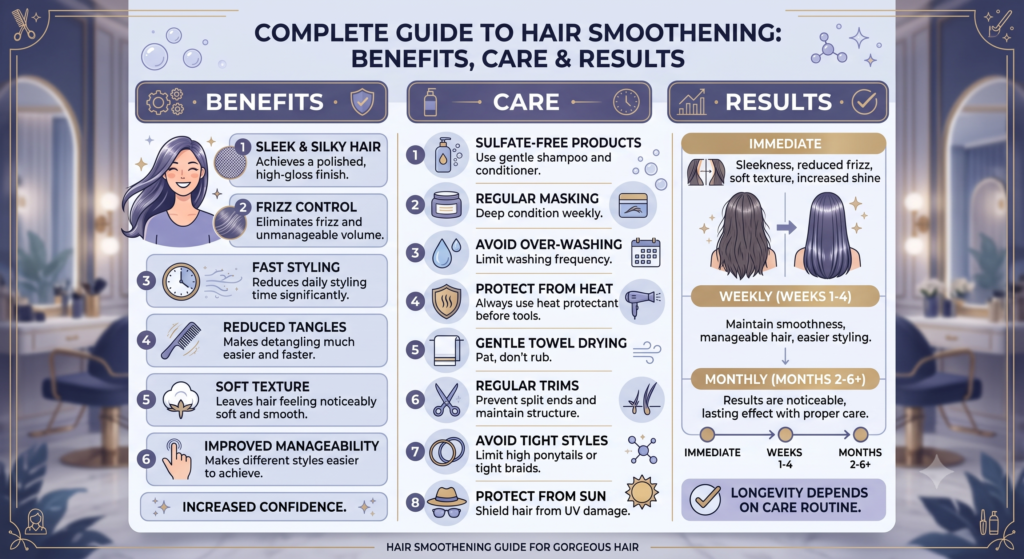
Hair smoothening is one of the most popular salon treatments for people who want softer, smoother, more manageable hair without spending hours styling it every day. Whether your hair is frizzy, dry, wavy, or difficult to manage, a professional smoothening service can help create a polished and well-groomed appearance.
However, getting the treatment is only the beginning. The results you get depend on several factors, including your hair type, the products used, the condition of your hair, the professional’s technique, and your aftercare routine.
In this complete guide, you’ll learn how hair smoothening works, its benefits, possible drawbacks, preparation tips, aftercare, maintenance, expected results, and how to decide whether it’s right for you.
What Is Hair Smoothening?
Hair smoothening is a professional chemical and heat-based salon treatment designed to reduce frizz, improve manageability, and create a smoother appearance. Unlike traditional permanent straightening, smoothening generally focuses on making the hair softer, more polished, and easier to style.
The exact formula and technique can vary between salons and products. Some treatments are designed mainly to control frizz, while others can noticeably loosen curls or waves.
The final result depends on your natural hair texture. For example, someone with mildly wavy hair may achieve a sleek, almost straight finish, while someone with tightly curly hair may see more relaxed curls rather than completely straight hair.
That’s why a professional consultation matters.
A trained stylist should examine your:
- Natural hair texture
- Previous chemical treatments
- Hair porosity
- Scalp condition
- Hair density
- Existing damage
- Colour-treated or highlighted sections
- Previous keratin or straightening services
A good stylist doesn’t simply apply a product and hope for the best. They should first understand what your hair can safely handle.
Why Is Hair Smoothening Popular?
Modern lifestyles are busy. Many people don’t want to spend 30–45 minutes every morning fighting frizz, tangles, and difficult styling.
Smoothening can make daily styling easier by giving the hair a more controlled texture. It may also help reduce the appearance of excessive frizz and improve shine.
However, it shouldn’t be considered a replacement for healthy hair care. The treatment changes the hair’s appearance and manageability, but maintaining healthy-looking hair still requires proper cleansing, conditioning, protection, and regular professional assessment.
How Does Hair Smoothening Work?
Although the exact process differs by product and salon, professional smoothening usually involves several stages.
1. Hair Consultation
The stylist first assesses the hair. This is one of the most important steps because previously bleached or chemically processed hair may require a different approach.
2. Cleansing
The hair is washed with a suitable cleansing shampoo to remove buildup, oil, and styling residue.
3. Sectioning
The stylist divides the hair into manageable sections. Proper sectioning allows the product to be applied evenly.
4. Product Application
The smoothening formula is carefully applied to the hair. Professional products are generally selected according to the hair’s condition and desired result.
5. Processing Time
The product remains on the hair for a specific amount of time. This stage must be controlled carefully.
6. Rinsing and Drying
Depending on the treatment system, the stylist may rinse the hair before drying or follow the manufacturer’s specific process.
7. Heat Styling
A professional flat iron or other heat tool may be used to help create the desired smooth finish.
8. Final Treatment
Some systems include a neutralizer or finishing treatment. The exact procedure depends on the product being used.
The most important point is that professional application matters. Incorrect processing time, excessive heat, or unsuitable products can affect the final result and hair condition.
Who Can Consider Hair Smoothening?
Hair smoothening may be suitable for people who want:
- Better frizz control
- Softer-looking hair
- Easier daily styling
- A smoother finish
- Reduced styling time
- More polished-looking waves or curls
- Better manageability
It can be particularly appealing if humidity causes your hair to become frizzy or difficult to control.
However, not every hair type should receive the same treatment.
Hair That May Need Extra Care
Hair that has been heavily bleached, extremely dry, severely damaged, or repeatedly chemically treated may require restoration before another chemical service.
A professional stylist may recommend postponing smoothening and focusing on conditioning or repair treatments first.
Never assume that a stronger formula means better results. Healthy-looking hair should always be the priority.
11 Major Benefits of Hair Smoothening
1. Reduces Visible Frizz
One of the biggest reasons people choose smoothening is frizz control. The treatment can help create a more uniform hair surface, making the hair appear more polished.
2. Makes Hair Easier to Manage
If brushing and styling take too long every morning, smoothening may simplify your routine.
3. Creates a Smoother Finish
The hair can look more refined and controlled after professional treatment.
4. Can Improve Shine
Smoother-looking strands often reflect light more evenly, which can make hair appear shinier.
5. Reduces Styling Time
You may spend less time using a blow dryer or straightener after washing your hair.
6. Helps Control Humidity-Related Frizz
For people living in humid climates, frizz control can be especially valuable.
7. Makes Hair More Manageable for Events
Smooth hair can make styling easier before weddings, parties, photoshoots, or special occasions.
8. Can Soften the Appearance of Waves
Depending on your natural texture and the treatment selected, waves may appear more relaxed.
9. Gives a Polished Appearance
The overall look can be neat, sleek, and salon-finished.
10. Can Make Daily Hair Care Simpler
Less effort in styling can make your everyday routine more convenient.
11. Provides a Customizable Result
A professional stylist can often adjust the approach depending on whether your goal is subtle frizz control or a noticeably smoother finish.
Hair Smoothening vs Hair Straightening
These two services are often confused, but they’re not necessarily the same.
| Feature | Hair Smoothening | Hair Straightening |
|---|---|---|
| Main goal | Smoothness and manageability | Straighter appearance |
| Frizz control | Usually strong | Strong |
| Natural movement | Often retained to some degree | May be reduced |
| Look | Smooth and polished | Straighter and more uniform |
| Suitable for | People wanting manageable hair | People wanting a straighter result |
| Maintenance | Depends on hair growth and treatment | Depends on technique and regrowth |
The right choice depends on your desired finish.
If you want hair that still looks relatively natural but is easier to manage, smoothening may be more appropriate.
If your primary goal is a much straighter appearance, another straightening system may be considered after professional consultation.
Hair Smoothening vs Keratin Treatment
Keratin treatments and smoothening services can both target frizz and improve manageability, but the formulas and intended results may differ.
A keratin service often focuses on smoothing, conditioning, and reducing frizz, while some smoothening treatments can create a more noticeable change in texture.
There isn’t one universal formula called “keratin” or “smoothening.” Different professional brands use different ingredients and application systems.
Therefore, don’t choose a treatment based only on its name.
Ask your stylist:
- What product will be used?
- What result should I realistically expect?
- Is my hair suitable?
- How should I maintain it afterward?
- What ingredients are included?
- How much heat will be required?
- Do I need a strand test?
For general information about cosmetic ingredient safety, consumers can also consult resources from the U.S. Food & Drug Administration.
How to Prepare for Hair Smoothening
Good preparation can help your stylist achieve a more predictable result.
Avoid Unnecessary Chemical Services
Try not to overload your hair with multiple chemical treatments close together.
Tell Your Stylist About Previous Treatments
Be honest about:
- Hair colour
- Bleaching
- Highlights
- Previous smoothening
- Keratin treatments
- Rebonding
- Perming
- Other chemical services
Even if a treatment happened several months ago, your stylist should know about it.
Don’t Hide Hair Damage
If your ends are extremely dry or breaking, tell the stylist. A professional may recommend improving the hair’s condition first.
Have a Consultation
A consultation is especially important if you’ve never had smoothening before.
The Professional Hair Smoothening Process
A quality salon should follow a controlled procedure rather than rushing through the appointment.
Step 1: Consultation
The stylist determines your hair type, condition, previous chemical history, and desired result.
Step 2: Hair Preparation
The hair is cleansed according to the treatment protocol.
Step 3: Product Application
The product is distributed carefully through sections of the hair while avoiding unnecessary contact with the scalp.
Step 4: Processing
The stylist monitors the hair throughout the recommended processing period.
Step 5: Rinsing
The hair is rinsed according to the product instructions.
Step 6: Blow-Drying
The hair is dried and prepared for the finishing stage.
Step 7: Heat Sealing
A professional flat iron may be used at a controlled temperature.
Step 8: Finishing
The stylist completes the treatment according to the product system and checks the final appearance.
A professional service isn’t simply about making hair look straight for a few hours. The goal should be a controlled, attractive result while respecting the condition of the hair.
Hair Smoothening Aftercare: What Should You Do?
Aftercare plays a major role in maintaining your result.
Use Suitable Hair-Care Products
Ask your stylist which shampoo, conditioner, and mask are suitable for your particular treatment.
Avoid randomly switching products just because they are advertised as “smooth hair” products.
Condition Regularly
Conditioner helps keep the hair feeling soft and manageable.
Use a Hair Mask
A nourishing mask once or twice a week can support the appearance of treated hair, depending on your hair’s needs.
Limit Excessive Heat
You may still use heat styling when necessary, but excessive heat can make chemically treated hair feel dry.
Always consider a suitable heat-protectant product.
Protect Your Hair From the Sun
Long exposure to strong sunlight can contribute to dryness and colour fading.
Avoid Overwashing
Wash your hair according to your scalp and hair needs rather than following a fixed rule.
Follow Your Stylist’s Instructions
Your stylist knows the exact product system used, so their specific aftercare instructions should take priority.
How Long Does Hair Smoothening Last?
There isn’t one fixed duration that applies to everyone.
The result can vary depending on:
- Hair texture
- Hair growth
- Washing frequency
- Shampoo and conditioner
- Heat styling
- Humidity
- Swimming
- Chemical colouring
- Hair-care routine
- Treatment formula
- Professional application
Many people notice that the treated lengths remain smoother while newly grown hair gradually returns to its natural texture.
This creates a visible difference between treated and untreated hair over time.
That’s why maintenance should be planned according to your hair’s condition rather than simply booking repeated treatments on a fixed schedule.
Possible Side Effects and Precautions
Like many chemical salon services, smoothening isn’t completely risk-free.
Possible concerns can include:
- Dryness
- Increased brittleness
- Breakage
- Scalp irritation
- Changes in curl pattern
- Damage from excessive heat
- Unwanted texture changes
The risk can increase if the hair is already compromised or if the treatment is applied incorrectly.
Why Professional Consultation Matters
A professional stylist can identify signs of excessive damage and determine whether your hair should be treated immediately.
If your scalp is irritated, injured, or unusually sensitive, tell the stylist before starting the service.
If you experience significant irritation during a chemical service, the process should be stopped and appropriate professional advice should be sought.
Common Hair Smoothening Mistakes to Avoid
Mistake 1: Choosing Only by Price
The cheapest service isn’t always the best value.
Mistake 2: Ignoring Hair History
Previous chemical services can affect how your hair responds.
Mistake 3: Using Random Products
Aftercare products should be compatible with your treatment and hair type.
Mistake 4: Excessive Straightening
Repeated high-temperature styling can contribute to dryness and breakage.
Mistake 5: Expecting Identical Results
Two people can receive the same treatment and get different results because their hair textures are different.
Mistake 6: Treating Damaged Hair Immediately
If the hair is already severely compromised, another chemical service may not be the right first step.
How to Maintain Healthy-Looking Smooth Hair
Smooth-looking hair still needs consistent care.
Create a simple routine:
Cleanse → Condition → Nourish → Protect → Trim → Professional Check
A balanced routine may include:
- Gentle cleansing
- Regular conditioning
- Occasional nourishing masks
- Heat protection
- Regular trims
- Limited unnecessary chemical processing
- Adequate hydration and nutrition
- Professional consultation when needed
Remember, smooth hair doesn’t automatically mean healthy hair. Appearance and hair condition are related, but they’re not exactly the same thing.
When Should You Get Hair Smoothening Again?
Avoid treating your hair simply because you think it’s “time.”
Instead, consider:
- How much new growth you have
- Whether the treated lengths still look smooth
- Your hair’s current strength
- Your styling needs
- Whether you’ve recently coloured or bleached your hair
- Your stylist’s recommendation
Repeated chemical treatments on the same lengths can increase stress on the hair.
A professional should determine whether a full treatment, root-focused service, or no additional chemical treatment is appropriate.
Frequently Asked Questions About Hair Smoothening
1. Is hair smoothening good for frizzy hair?
Yes, hair smoothening is commonly chosen to reduce visible frizz and improve manageability. However, the final result depends on your natural texture, hair condition, and the treatment formula.
2. Does hair smoothening make hair permanently straight?
Not necessarily. Smoothening is generally designed to create smoother and more manageable hair rather than guarantee permanently straight hair. New growth will continue to reflect your natural texture.
3. How long does hair smoothening last?
The duration varies from person to person. Hair growth, washing habits, humidity, treatment formula, and aftercare can all affect how long the result remains noticeable.
4. Can coloured hair get smoothening?
Sometimes, yes, but coloured or chemically treated hair needs careful assessment. If the hair is heavily bleached or damaged, a stylist may recommend waiting or improving its condition first.
5. Can I colour my hair after smoothening?
The timing depends on the treatment system, hair condition, and colour service. Ask your stylist before combining chemical services.
6. Is hair smoothening suitable for curly hair?
It can be, depending on the desired result. Smoothening may relax curls or reduce frizz, but it doesn’t guarantee the same result on every curl pattern.
7. Can I use a straightener after smoothening?
You can often use heat styling when necessary, but excessive heat can contribute to dryness and breakage. Use appropriate heat protection and avoid unnecessarily high temperatures.
8. Should I use special shampoo after smoothening?
Your stylist may recommend specific products based on the treatment system. Choosing suitable cleansing and conditioning products can help maintain the hair’s appearance and condition.
9. Is professional smoothening better than doing it at home?
Professional treatment allows a trained stylist to assess your hair, select an appropriate formula, control processing, and manage heat application. This can reduce the risk of unsuitable treatment.
10. Can damaged hair receive smoothening?
Severely damaged hair may not be a good candidate. A professional should assess the hair first and may recommend repair-focused care before another chemical treatment.
Conclusion
Hair smoothening can be an excellent option for people who want smoother, more manageable, polished-looking hair and less daily styling effort. However, the best results come from choosing the right treatment for your hair rather than simply choosing the strongest or most popular option.
Start with a professional consultation, understand the expected result, disclose your complete chemical history, and follow a consistent aftercare routine. Most importantly, remember that beautiful hair is not only about smoothness—it’s also about maintaining strength, softness, and overall condition.
If you’re considering smoothening, speak with an experienced salon professional who can assess your hair and recommend a treatment based on your individual needs.
Ready for smoother, more manageable hair? Book a professional consultation and discover the right smoothening solution for your hair type.