
What Is Hair Botox?
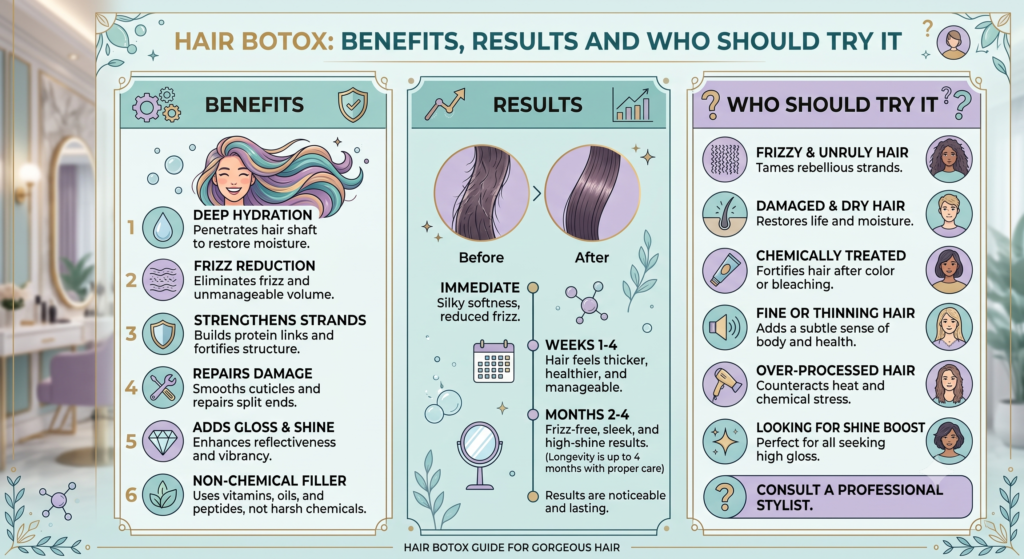
Hair botox is a deep-conditioning and smoothing treatment that aims to make hair look healthier, softer, shinier, and more manageable.
Unlike injectable Botox, hair botox doesn’t involve injections or botulinum toxin. The name is mainly used as a marketing term because the treatment can give hair a temporarily “filled,” smoother, and more polished appearance.
The exact formulation varies between professional products and salons. Some formulas may contain ingredients such as:
- Keratin or other proteins
- Amino acids
- Collagen
- Vitamins
- Natural oils
- Fatty acids
- Conditioning agents
- Plant-based extracts
The treatment is generally applied to the hair length rather than the scalp. Professional application is important because the correct product, processing time, heat level, and finishing technique can affect the final result.
Why Is It Called Hair Botox?
The term comes from the idea of “filling” or smoothing damaged-looking areas of the hair fiber.
Think of it this way: when hair becomes rough and porous, its surface can look uneven. A conditioning treatment can coat and smooth that surface, helping the hair appear more uniform and glossy.
However, it’s important not to confuse the cosmetic name with medical Botox. Hair botox doesn’t work by relaxing muscles or changing facial movement.
Hair Botox vs Traditional Botox
| Hair Botox | Injectable Botox |
|---|---|
| Cosmetic hair treatment | Medical/cosmetic injectable procedure |
| Applied to hair | Injected into specific muscles |
| Doesn’t contain botulinum toxin simply because it’s called “Botox” | Uses botulinum toxin |
| Designed to condition and smooth hair | Used for specific medical/cosmetic purposes |
| Performed by trained salon professionals | Performed by qualified medical professionals |
For general information about hair and scalp health, the American Academy of Dermatology is a useful educational resource.
How Does Hair Botox Work?
Hair botox treatments generally focus on improving the surface appearance and manageability of the hair.
During the process, a professional applies a treatment formula to clean hair. Depending on the product, the formula may be left on for a specific amount of time before the hair is rinsed, dried, and sometimes heat-sealed with a professional styling tool.
The exact process differs by brand, hair type, and salon protocol.
What Happens During the Treatment?
A typical salon appointment may involve the following steps:
- Hair assessment – The stylist examines the hair’s texture, condition, density, and previous chemical treatments.
- Cleansing – Hair is washed with a suitable shampoo to remove buildup.
- Product application – The hair botox formula is distributed through sections of the hair.
- Processing – The product remains on the hair for the recommended period.
- Rinsing – Some formulations require partial or complete rinsing.
- Blow-drying – Hair is dried carefully.
- Heat finishing – Depending on the product, a flat iron may be used to help create a smoother finish.
- Final styling – The hair is styled and checked for overall appearance.
A professional should always follow the manufacturer’s instructions instead of using one universal process for every client.
Key Ingredients Used
Hair botox formulas can differ significantly. Common ingredients may include proteins and amino acids that help improve the feel and appearance of damaged or porous hair.
Some products may also include moisturizing ingredients and oils to support softness and shine.
That’s why it’s worth asking your stylist which exact product is being used and what ingredients it contains.
10 Major Benefits of Hair Botox
Hair botox has become popular because it can provide several visible cosmetic benefits in one appointment.
1. Helps Reduce the Appearance of Frizz
One of the main reasons people choose hair botox is frizz control.
When hair looks rough or puffy, a smoothing treatment may help create a more controlled appearance. This can be particularly useful for people who struggle with humidity-related frizz.
2. Enhances Shine
Healthy-looking hair usually reflects light more evenly.
By smoothing the outer surface of the hair, conditioning treatments can make strands appear shinier and more polished.
3. Makes Hair Feel Softer
Dry hair can feel coarse and rough. A deep conditioning treatment may improve the immediate feel of the hair, making it feel softer and easier to touch.
4. Improves Manageability
If your morning routine involves fighting with tangles and frizz, smoother hair can make styling easier.
Hair may become easier to brush, blow-dry, and style after treatment.
5. Improves the Appearance of Damaged Hair
Hair botox doesn’t permanently repair every form of structural damage. However, conditioning and smoothing ingredients can temporarily improve how damaged hair looks and feels.
This can make dry or over-processed hair appear more polished.
6. Creates a Smoother Finish
The treatment can help reduce the appearance of roughness and uneven texture.
The result is often hair that looks smoother without necessarily becoming completely straight.
7. Can Make Styling Easier
Smoother hair generally takes less effort to style.
For busy clients, that’s a practical advantage. Less frizz and improved manageability can make daily styling quicker.
8. Can Improve the Feel of Porous Hair
Highly porous hair can absorb and lose moisture quickly.
Conditioning treatments may help improve the feel and appearance of porous strands, although they don’t permanently change the natural porosity of the hair.
9. Can Improve the Look of Split Ends
Some treatments can temporarily make split ends look less obvious by smoothing and coating the hair.
However, a split end is physically split. The only permanent way to remove it is to cut it.
10. Gives Hair a Polished, Salon-Fresh Appearance
Perhaps the most noticeable benefit is the overall finish.
Hair may look:
- Smoother
- Softer
- Shinier
- More controlled
- Less frizzy
- Easier to style
That’s why hair botox can be appealing before special occasions, events, holidays, or simply as part of a regular hair-care routine.
Hair Botox Results: What Can You Expect?
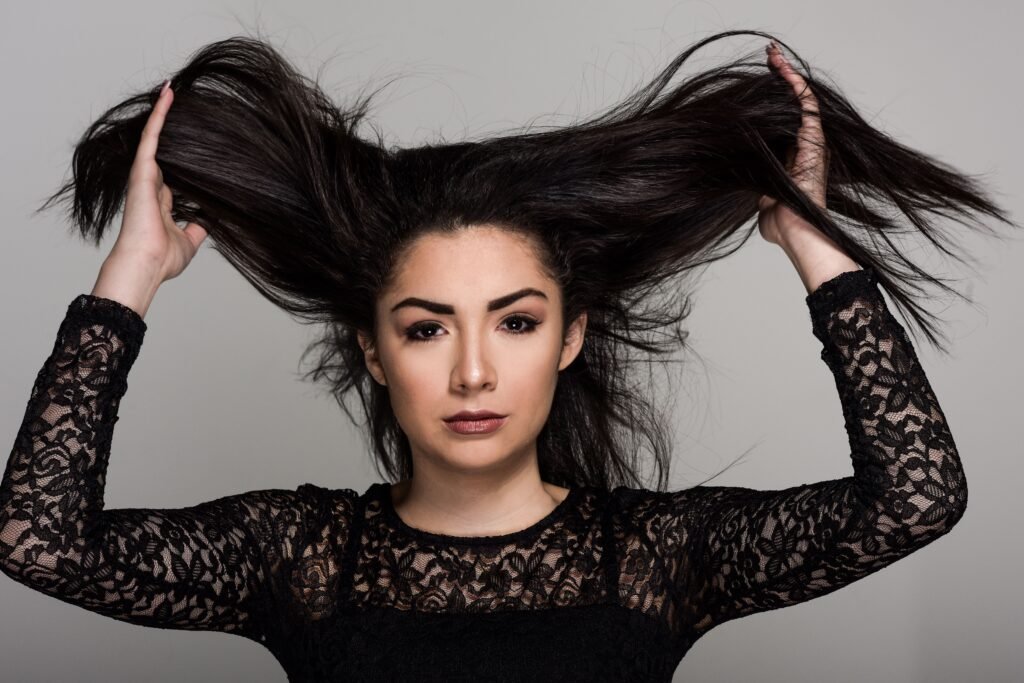
Results vary depending on the individual’s hair condition, texture, previous chemical treatments, lifestyle, and the specific product used.
Some clients may notice an improvement in softness and shine immediately after the appointment. Others may see a more noticeable change in frizz and manageability after styling.
Before and After Expectations
A realistic expectation is smoother, shinier, softer-looking hair, rather than completely straight hair.
Hair botox isn’t necessarily designed to remove your natural texture.
For example:
- Curly hair may remain curly but appear more controlled.
- Wavy hair may look smoother.
- Frizzy hair may appear more polished.
- Dry hair may feel softer.
- Chemically treated hair may look healthier temporarily.
The final result depends heavily on the starting condition of the hair.
How Long Do Results Last?
The longevity of results varies.
Factors that can influence durability include:
- Hair-washing frequency
- Shampoo formulation
- Heat styling
- Swimming
- Sun exposure
- Hair texture
- Product formulation
- Aftercare routine
Many salon treatments are marketed as lasting for several weeks to a few months, but there isn’t one guaranteed duration for everyone.
Your stylist should provide product-specific guidance.
Who Should Try Hair Botox?
Hair botox may be worth considering if your main concerns are frizz, dryness, rough texture, dullness, or difficult-to-manage hair.
Dry and Frizzy Hair
If your hair regularly looks dry or puffy, a smoothing conditioning treatment may help improve its cosmetic appearance.
This can be especially useful when humidity makes frizz worse.
Chemically Treated Hair
Coloring, bleaching, straightening, and other chemical services can change the condition and feel of the hair.
A professional can assess whether hair botox is appropriate based on the current strength and condition of the strands.
Heat-Damaged Hair
Frequent use of:
- Straighteners
- Curling irons
- Blow dryers
- Hot brushes
can contribute to dryness and breakage.
If your hair has become rough from frequent styling, a conditioning treatment may improve its appearance.
However, severe breakage shouldn’t simply be covered with a smoothing service. Your stylist should assess the hair first.
Who Should Avoid or Delay Hair Botox?
Hair botox isn’t automatically suitable for everyone.
You may need to delay or reconsider the treatment if your hair is:
- Severely damaged
- Breaking excessively
- Extremely fragile
- Recently subjected to multiple chemical services
- Experiencing unexplained hair loss
- Showing signs of scalp irritation
If you have an active scalp condition, unexplained shedding, or significant breakage, speak with a dermatologist or qualified healthcare professional rather than relying solely on a salon treatment.
A good stylist should also perform a consultation before applying chemicals or heat.
Hair Botox vs Keratin vs Smoothening
These treatments are often confused because all three can create a smoother appearance. However, they’re not necessarily identical.
| Feature | Hair Botox | Keratin Treatment | Hair Smoothening |
|---|---|---|---|
| Main goal | Conditioning and smoothing | Smoothing and frizz control | Smoother, more manageable hair |
| Straightening effect | Usually mild to moderate | Varies by formula | Often more noticeable |
| Frizz control | Yes | Yes | Yes |
| Shine | Often improved | Often improved | Often improved |
| Texture | Usually preserved to some degree | May alter texture | Can alter texture more |
| Best for | Dry, frizzy, rough hair | Frizz and manageability | Clients wanting a smoother look |
The exact result depends on the product and technique. Product names alone aren’t enough to predict the final outcome.
Hair Botox Treatment Process at a Professional Salon
Choosing a professional salon can make a major difference.
A quality consultation should begin with an examination of your hair.
Step 1: Consultation
Your stylist should ask about:
- Previous coloring
- Bleaching
- Keratin treatments
- Smoothening
- Hair botox
- Heat styling
- Current hair concerns
Step 2: Hair Preparation
The hair is cleansed according to the product’s instructions.
Step 3: Treatment Application
The formula is applied section by section to ensure even coverage.
Step 4: Processing
The treatment is left for the recommended time.
Step 5: Rinse and Dry
Depending on the product, the hair may be rinsed partially or completely before drying.
Step 6: Finishing
A blow-dry and/or flat-iron process may be used according to the treatment system.
Step 7: Final Assessment
The stylist checks the hair’s finish, texture, and overall appearance.
A professional treatment shouldn’t be rushed. Hair type, length, density, and condition all matter.
Hair Botox Aftercare Tips
Good aftercare can help you maintain the salon-fresh appearance for longer.
Use a Suitable Shampoo
Ask your stylist which shampoo is compatible with your specific treatment.
Avoid randomly changing products immediately after a professional service.
Don’t Overwash
Washing too frequently may cause smoothing and conditioning effects to fade sooner.
Reduce Excessive Heat
Even treated hair needs protection from heat.
Use a heat protectant before using styling tools.
Condition Regularly
A suitable conditioner or hair mask can help maintain softness and manageability.
Protect Your Hair From Sun and Chlorine
If you’re spending time outdoors or swimming, take protective measures.
A swimming cap can be useful in pools, while covering the hair can reduce prolonged environmental exposure.
Don’t Ignore Your Hair’s Condition
If you notice unusual breakage, scalp irritation, or significant shedding, stop experimenting with treatments and seek professional advice.
Possible Side Effects and Safety Considerations
Hair treatments can affect people differently.
Possible concerns may include:
- Scalp irritation
- Sensitivity to ingredients
- Dryness
- Breakage from excessive heat
- Strong fumes from certain formulations
Not every hair botox product has the same ingredients, so it’s important to check the product label and follow the manufacturer’s instructions.
If you have sensitive skin or known allergies, discuss them with your stylist before treatment.
A patch or strand test may also be appropriate depending on the product and salon protocol.
Professional application matters. A trained stylist can assess whether your hair is suitable and choose an appropriate treatment approach.
How Much Does Hair Botox Cost?
The cost of hair botox varies widely depending on:
- Hair length
- Hair thickness
- Product brand
- Salon location
- Stylist experience
- Treatment formulation
- Hair condition
Long, thick hair generally requires more product and more working time than short hair.
Instead of choosing a salon based only on the cheapest price, consider the quality of the product, consultation, hygiene, stylist experience, and aftercare guidance.
Frequently Asked Questions About Hair Botox
1. Is hair botox the same as regular Botox?
No. Hair botox is a cosmetic hair treatment and isn’t the same as injectable botulinum toxin used in medical or cosmetic procedures.
2. Does hair botox permanently straighten hair?
Usually, no. Hair botox is primarily associated with conditioning, smoothing, shine, and frizz control. The degree of straightening depends on the specific product and technique.
3. Is hair botox good for frizzy hair?
It can be a useful option for people who want to reduce the appearance of frizz and make their hair easier to manage. Results vary by hair type and product.
4. Can colored hair get hair botox?
In many cases, yes, but the hair’s condition should be assessed first. Recently bleached or highly processed hair may require extra caution.
5. How long does hair botox last?
The duration varies from person to person. Hair-washing habits, products, heat styling, swimming, hair texture, and the treatment formula can all affect longevity.
6. Does hair botox repair damaged hair?
It can improve the appearance and feel of damaged hair, but it shouldn’t be considered a permanent repair for severe structural damage. Damaged ends may still need trimming.
7. Can men get hair botox?
Absolutely. Hair botox isn’t gender-specific. Anyone looking for smoother, softer, more manageable hair can discuss the treatment with a professional stylist.
8. Can curly hair get hair botox?
Yes, depending on the desired result and the product. People with curly hair should clearly tell their stylist whether they want to preserve their natural curls or achieve a smoother finish.
9. Is hair botox suitable for short hair?
Yes. Hair length doesn’t automatically determine suitability. The treatment can be considered for short, medium, or long hair depending on its condition and the client’s goals.
10. Should I get hair botox before a special event?
It can be an option if you want smoother, shinier, more manageable hair for an event. Ideally, schedule the service with enough time to address any unexpected reaction or result before the occasion.
Conclusion: Is Hair Botox Worth Trying?
Hair botox can be a practical option for people who want smoother, softer, shinier, and more manageable-looking hair without necessarily changing their natural texture completely.
Its biggest appeal is the combination of conditioning and smoothing benefits. It can help improve the appearance of dry, frizzy, rough, dull, or difficult-to-style hair.
However, expectations matter. Hair botox isn’t a permanent cure for damaged hair, and the results depend on the formula, application technique, hair condition, and aftercare routine.
If you’re considering the treatment, start with a professional consultation. A skilled stylist can examine your hair and recommend whether hair botox, keratin, smoothening, or another treatment is the better choice for your specific needs.
With the right treatment and proper aftercare, you can enjoy hair that looks smoother, feels softer, and is easier to style.