Keratin vs Smoothening vs Hair Botox: Which Treatment Is Right for You? – The Ultimate 7-Point Guide
Introduction: Why Choosing the Right Hair Treatment Matters
Frizzy, rough, dry, unmanageable hair can make everyday styling feel like a chore. You may spend a lot of time with a straightener, serum, or blow dryer, only to see frizz return when the weather changes.
That’s where professional hair treatments come in.
Among the most popular options are keratin treatment, hair smoothening, and hair Botox. While people often use these terms interchangeably, they don’t deliver exactly the same result.
Some treatments focus more on reducing frizz. Others are designed to make hair look straighter and more controlled. Hair Botox, meanwhile, is generally chosen by people who want smoother-looking, softer, healthier-looking hair without necessarily aiming for a very straight finish.
So, which one should you choose?
The answer depends on what you actually want from your hair.
If you’re looking for frizz control and smoother styling, one treatment may be a better fit. If your main goal is a straighter appearance, another may make more sense. And if your hair looks dry, dull, porous, or stressed from repeated styling, a conditioning-focused treatment could be worth considering.
This guide breaks down the major differences between these treatments in simple language.
Important: Professional hair treatments vary significantly by product, formulation, technique, heat level, and stylist expertise. Always ask your salon which specific product is being used and what result it is designed to provide.
1. What Is a Keratin Treatment?
A keratin treatment is a professional hair-smoothing service designed primarily to improve manageability, reduce frizz, and create a smoother-looking finish.
Keratin is a protein naturally found in hair. However, salon “keratin treatments” aren’t simply replacing lost keratin inside your hair. They typically involve applying a formulated product and using heat to create a smoother cosmetic result.
Depending on the formulation and technique, the finished hair can look:
Smoother
Shinier
Less frizzy
Easier to style
More controlled
Straighter-looking
The exact result varies from person to person.
How Does a Keratin Treatment Work?
The stylist generally begins by cleansing the hair and preparing it for the treatment. A professional smoothing formulation is then applied section by section.
After processing according to the product’s instructions, the stylist uses heat, often through blow-drying and flat ironing, to finish the service.
The heat and product combination helps create the smoother appearance associated with the treatment.
However, “keratin” isn’t a single standardized treatment. Different brands and formulations can have very different ingredients and instructions.
That’s why it’s better to ask which product and formulation your stylist is using, rather than choosing a treatment based only on the word “keratin.”
Who May Benefit From Keratin Treatment?
Keratin can be appealing if you have:
Frizzy hair
Wavy hair that feels difficult to manage
Humidity-related frizz
Hair that takes too long to style
Rough-looking hair
A desire for smoother styling
A preference for a polished finish
It’s particularly useful for people who want to spend less time fighting frizz every morning.
What About Safety?
This is an important point.
Some hair-smoothing products can contain or release formaldehyde when heated. The U.S. FDA advises consumers to check ingredients and ask salon professionals about the product being used.
For this reason, don’t assume that every keratin treatment is identical.
Ask your salon:
What product are you using?
Can I see the ingredient information?
Does the product contain formaldehyde, formalin, or methylene glycol?
What ventilation and safety precautions are used?
Is the treatment appropriate for my hair condition?
A professional salon should be comfortable answering these questions.
2. What Is Hair Smoothening?
Hair smoothening is a broader term used for professional services designed to make hair appear smoother, more controlled, and often straighter.
Unlike a simple blow-dry, smoothening is intended to provide a longer-lasting cosmetic change in the hair’s appearance.
Depending on the technique and product, smoothening can reduce:
Frizz
Puffiness
Unwanted waves
Rough texture
Daily styling time
The final result can range from naturally straight-looking hair to a much more polished finish.
Is Smoothening the Same as Straightening?
Not necessarily.
People sometimes use “smoothening” and “straightening” as if they’re identical. In reality, the exact result depends on the formulation, technique, hair type, and stylist.
Some services aim for a natural, smooth finish rather than completely flat hair.
If you want your natural movement to remain, tell your stylist before the service.
Who Should Consider Smoothening?
Smoothening may be suitable for someone who wants:
A straighter appearance
Reduced frizz
Easier everyday styling
A polished finish
Less volume or puffiness
More predictable hair in humid weather
However, hair history matters.
If your hair has been heavily bleached, repeatedly colored, chemically treated, or exposed to excessive heat, a professional consultation becomes especially important.
Why Hair History Matters
Think of your hair like fabric.
If you repeatedly bleach, color, heat-style, and chemically process it, the hair can become more fragile. Adding another chemical service without assessing its condition may not be the best idea.
That’s why a good stylist shouldn’t simply ask, “Which treatment do you want?”
They should ask:
Have you colored your hair?
Have you bleached it?
Have you had a previous chemical treatment?
When was your last treatment?
Do you use heat frequently?
Is your hair breaking?
How does your hair behave after washing?
Those answers can completely change the recommendation.
3. What Is Hair Botox?
Despite the name, hair Botox isn’t Botox injections.
It’s a cosmetic hair treatment generally marketed around deep conditioning, smoothing, softening, reducing frizz, and improving the appearance of damaged or dry-looking hair.
The formula can vary considerably between brands and salons.
Hair Botox is often chosen by people who don’t necessarily want extremely straight hair but would like hair that looks:
Softer
Smoother
Shinier
More manageable
Less frizzy
Healthier-looking
Why Is It Called Hair Botox?
The name is mainly a beauty-industry term.
Hair Botox isn’t the same thing as medical Botox and doesn’t involve injecting botulinum toxin into the hair or scalp.
The term is commonly used to describe a conditioning and smoothing concept where the hair is coated or treated with cosmetic ingredients designed to improve its appearance.
Is Hair Botox Good for Damaged Hair?
It can be an attractive option for hair that looks dry, dull, rough, or stressed.
But there’s an important distinction:
A cosmetic treatment can improve the appearance and feel of damaged hair, but it can’t magically turn severely damaged hair back into untouched virgin hair.
If your ends are severely split or your hair is breaking, a haircut and a properly planned hair-care routine may be just as important as any salon treatment.
Who May Prefer Hair Botox?
Hair Botox may appeal to you if:
You want smoother-looking hair
You want softness and shine
You don’t want an extremely straight finish
Your hair feels dry or rough
Your hair is difficult to manage
You want a more polished appearance
Still, don’t select it simply because it sounds gentler.
The actual formulation matters more than the marketing name.
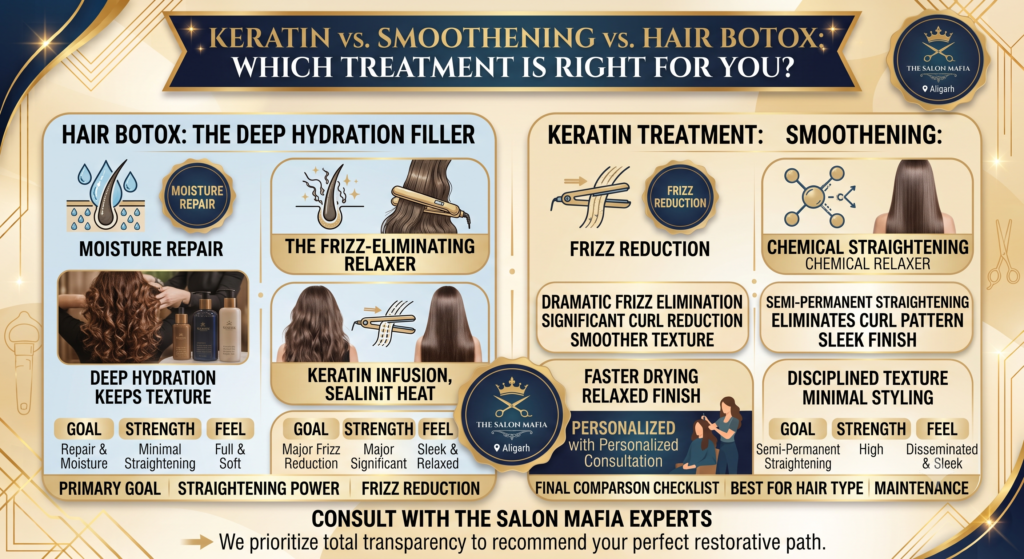
4. Keratin vs Smoothening vs Hair Botox: Key Differences
Now let’s get to the main question.
Keratin vs smoothening vs hair Botox isn’t really a battle where one treatment wins for everyone.
Each service can have a different purpose.
Feature
Keratin
Smoothening
Hair Botox
Main goal
Frizz control and smoothness
Smoother/straighter appearance
Conditioning and smoother appearance
Frizz reduction
High
High
Moderate to high
Straightness
Moderate to high
High, depending on formula
Low to moderate
Shine
Usually high
Usually high
Usually high
Softness
High
Moderate to high
High
Natural movement
Can remain
May reduce
Usually better preserved
Best for
Frizzy, unruly hair
People wanting straighter hair
Dry, rough, dull-looking hair
Maintenance
Requires aftercare
Requires aftercare
Requires aftercare
Formula variation
High
High
Very high
These are general comparisons. Your actual result can differ based on your hair’s condition and the specific salon product.
Keratin vs Smoothening
If your primary goal is frizz control with smoother, manageable hair, keratin may be worth discussing.
If you want a straighter and more controlled appearance, smoothening may be the stronger candidate.
But there’s a catch.
Neither name tells you exactly what the product will do.
Always discuss the desired finish with your stylist.
Keratin vs Hair Botox
This comparison is often about priorities.
Choose keratin when your biggest concern is:
Frizz
Manageability
Smoother styling
Humidity control
Hair Botox may be more appealing when your concerns are:
Dryness
Roughness
Dull appearance
Lack of softness
Hair that needs a conditioning-focused service
Again, product formulations vary.
Smoothening vs Hair Botox
This is perhaps the easiest comparison.
If you want straighter-looking hair, smoothening is usually the service people consider first.
If you want smoother, softer, healthier-looking hair while retaining more natural movement, hair Botox may be worth discussing.
5. Which Treatment Is Best for Your Hair Type?
Your hair type is one of the biggest factors when selecting a treatment.
For Wavy Hair
Wavy hair often responds well to smoothing services because frizz can make the natural pattern look uneven.
Keratin may help control frizz while keeping some movement.
Smoothening can create a straighter result.
Hair Botox may work well when the hair is dry or rough and the main goal is softness.
For Curly Hair
Curly hair requires a more personalized approach.
Ask yourself:
Do I want to keep my curls or make my hair straighter?
If you love your curls but dislike frizz, an appropriate smoothing or conditioning service may be preferable.
If you want a significantly straighter appearance, a more intensive service may be considered.
Don’t let the stylist guess your preference. Be specific.
For Frizzy Hair
If frizz is your number-one concern, keratin is often one of the first options people discuss.
However, hair Botox and smoothening can also provide frizz reduction depending on the product.
The important thing is to identify why your hair is frizzy.
Possible reasons include:
Dryness
Humidity
Hair damage
Natural texture
Excessive heat
Improper hair care
Chemical processing
For Dry and Damaged Hair
This is where you need to slow down.
If your hair is extremely dry or breaking, don’t automatically choose the strongest treatment.
A stylist should examine:
Elasticity
Porosity
Breakage
Previous chemical services
Scalp condition
Hair density
Split ends
A conditioning-focused service may be more appropriate than a straightening-focused service in some cases.
6. How Long Do These Treatments Last?
There isn’t one universal duration.
Results depend on:
Product formulation
Hair type
Hair washing frequency
Shampoo used
Heat styling
Swimming
Sun exposure
Home-care routine
Original hair texture
Some people may notice results for several months, while others see their desired effect change sooner.
Does Shampoo Affect Results?
Absolutely.
Aftercare can make a noticeable difference in how long a salon treatment looks its best.
Your stylist may recommend specific shampoo and conditioner depending on the treatment.
Instead of buying products simply because they’re labeled “aftercare,” ask why they’re recommended and how they support your specific treatment.
Can You Wash Your Hair Normally?
Follow the instructions given for your exact treatment.
Different services have different post-treatment instructions, so generic internet advice isn’t always reliable.
7. Hair Botox, Keratin, or Smoothening: Which Is Better for Frizz?
If your main concern is frizz, don’t immediately assume you need the strongest treatment.
Frizz can come from many causes.
For example, naturally curly hair may look frizzy because of humidity. Dry hair may look frizzy because the surface isn’t smooth. Chemically damaged hair may look rough because the cuticle has been stressed.
Best General Choices
For maximum frizz control: Keratin or a professional smoothing service may be considered.
For a straighter appearance: Smoothening may be more suitable.
For softness and conditioning: Hair Botox may be worth considering.
But these are starting points, not fixed rules.
A professional consultation should determine the final recommendation.
8. Which Treatment Causes More Hair Damage?
This is one of the most common questions clients ask.
The answer isn’t simply “keratin” or “smoothening.”
Potential stress on hair depends on:
Chemical formulation
Processing time
Temperature
Number of flat-iron passes
Existing damage
Stylist technique
Frequency of treatments
High heat can be especially important because the treatment process may involve repeated heat styling.
Some smoothing products can also release formaldehyde when heated. The FDA specifically recommends checking product ingredients and asking salon professionals about safety precautions.
Terms such as “organic,” “natural,” or “chemical-free” can sound reassuring, but they don’t tell you everything about how a product behaves.
Instead, ask for:
Product name
Ingredient information
Manufacturer instructions
Safety Data Sheet where applicable
Recommended processing method
An informed decision is better than relying on marketing claims.
9. How to Choose the Right Treatment at a Salon
Before booking your treatment, decide what result you actually want.
Use this simple guide:
Choose Keratin If You Want:
Less frizz
Smoother hair
Easier styling
More shine
Better humidity control
Consider Smoothening If You Want:
Straighter-looking hair
Less volume
A polished finish
Reduced waves
Easier daily styling
Consider Hair Botox If You Want:
Softness
Shine
Smoother-looking hair
Better manageability
A conditioning-focused result
Less emphasis on completely straight hair
The best treatment is the one that matches your desired result and your hair’s current condition.
10. Questions to Ask Your Stylist Before Treatment
Don’t be shy about asking questions.
A professional consultation should feel like a conversation, not a sales pitch.
Ask:
What treatment would you recommend for my hair and why?
What result should I realistically expect?
Will my hair become completely straight?
What product are you using?
Can I see the ingredient information?
Is the product suitable for previously colored hair?
What heat will be used during the service?
How long will the treatment take?
What aftercare products should I use?
How often can I repeat the treatment?
The FDA also recommends that consumers ask salon professionals about ingredients, product safety information, training, ventilation, and alternatives where appropriate.
11. What Happens During a Professional Treatment?
Although the exact process varies, most professional services follow a similar general structure.
Step 1: Consultation
Your stylist examines your hair and discusses your goal.
Step 2: Hair Assessment
The stylist checks texture, density, dryness, previous chemical work, and overall condition.
Step 3: Cleansing
The hair is prepared according to the product’s instructions.
Step 4: Product Application
The chosen formulation is applied carefully, usually section by section.
Step 5: Processing
The product remains on the hair for the manufacturer-recommended time.
Step 6: Blow-Drying and Heat Styling
Depending on the service, heat is used to finish the treatment.
Step 7: Final Styling
The hair is styled to reveal the finished result.
A skilled stylist should avoid treating every client’s hair exactly the same way.
12. Hair Treatment Aftercare Tips
The salon appointment is only part of the process.
Your home routine matters too.
Use Recommended Hair Care
Follow your stylist’s product recommendations based on your treatment.
Avoid Excessive Heat
Even treated hair can become stressed by frequent high-temperature styling.
Use heat protection when appropriate.
Don’t Overwash
Washing frequency can affect how long certain treatments remain noticeable.
Protect Your Hair From Environmental Stress
Sun, humidity, swimming, and frequent washing can all affect the look and feel of treated hair.
Keep Your Hair Conditioned
A good conditioner or treatment mask can help maintain softness and manageability.
Schedule Follow-Ups Carefully
Don’t repeatedly book chemical or smoothing services without assessing the condition of your hair first.
13. Common Mistakes People Make
Choosing the Treatment Based on a Friend’s Hair
Your friend’s hair isn’t your hair.
Different textures and histories can produce different results.
Expecting Permanent Results
Most cosmetic smoothing treatments aren’t permanent.
New hair growth will also reflect your natural texture.
Ignoring Previous Chemical Treatments
Bleached or heavily colored hair may need a different approach.
Focusing Only on Price
The cheapest service isn’t automatically the best value.
A professional consultation, quality product, skilled technique, proper ventilation, and appropriate aftercare all matter.
Assuming Hair Botox Means Zero Chemicals
All cosmetic hair treatments use formulations containing ingredients. The term “Botox” doesn’t mean the service is chemical-free.
Trying Professional Smoothing Products at Home
This isn’t a good shortcut.
The FDA advises consumers not to use hair-smoothing products containing formaldehyde or related ingredients at home and recommends professional application and appropriate precautions.
14. Keratin vs Smoothening vs Hair Botox: Quick Decision Chart
Your Main Goal
Treatment to Discuss
Reduce frizz
Keratin
Make hair look straighter
Smoothening
Improve softness
Hair Botox
Add a polished appearance
Keratin or Smoothening
Manage humidity-related frizz
Keratin/Smoothing
Keep more natural movement
Hair Botox
Reduce daily styling time
Keratin/Smoothening
Dry, rough-looking hair
Hair Botox
Strongly controlled straight look
Smoothening
Remember, these are general guidelines rather than guarantees.
15. How Much Does a Hair Treatment Cost?
Salon treatment prices can vary widely.
Factors include:
City
Salon level
Hair length
Hair density
Product brand
Treatment type
Stylist experience
Hair condition
Additional services
Longer and thicker hair generally requires more product and time.
Instead of asking only, “How much does keratin cost?” ask for a complete quotation after consultation.
A professional salon should be able to explain what is included in the price.
FAQ’s
1. Is keratin better than smoothening?
Not necessarily. Keratin is often selected for frizz control and manageability, while smoothening is commonly chosen when a straighter appearance is desired. The best option depends on your hair condition and desired finish.
2. Is hair Botox better than keratin?
Neither is universally better. Hair Botox is often chosen for softness, conditioning, shine, and smoother-looking hair, while keratin is commonly chosen for stronger frizz control and manageability.
3. Which treatment makes hair the straightest?
Smoothening generally targets a straighter-looking result, but the exact result depends on the product, technique, hair texture, and starting condition.
4. Does hair Botox straighten hair?
Hair Botox can make hair look smoother and less frizzy, but it isn’t necessarily designed to produce the same straightening effect as a dedicated smoothing service.
5. How long does keratin treatment last?
The visible effect varies from person to person. Hair-washing frequency, product formulation, home care, hair type, and environmental exposure can all affect how long the results remain noticeable.
6. Can I get keratin on colored hair?
It may be possible, but the answer depends on the condition of the colored hair and the specific product. Always tell your stylist about previous color, bleach, or chemical services.
7. Is smoothening safe for damaged hair?
Not automatically. Severely damaged or fragile hair needs careful assessment before any chemical or high-heat service. Your stylist may recommend postponing the treatment or choosing a different approach.
8. Can I do keratin treatment at home?
Professional smoothing services involve product selection, application, heat control, and safety considerations. The FDA advises consumers against using hair-smoothing products containing formaldehyde or related ingredients at home.
9. Which treatment is best for frizzy hair?
Keratin or a suitable smoothing service may be considered for significant frizz, while hair Botox can also help create a smoother-looking finish. Your hair’s condition should determine the final choice.
10. Which treatment is best for dry hair?
If dryness and roughness are your primary concerns, a conditioning-focused treatment such as hair Botox may be worth discussing. However, severely damaged hair may need restorative care and trimming before any chemical service.
11. Can I use a straightener after keratin?
You can usually style treated hair according to your stylist’s aftercare instructions, but unnecessary high heat should be avoided. Always use suitable heat protection.
12. Can I repeat these treatments regularly?
Potentially, but frequency should be based on your hair’s condition, the product instructions, and your stylist’s assessment. Repeating chemical and high-heat treatments too frequently may increase stress on already fragile hair.
Final Verdict: Which Treatment Should You Choose?
There isn’t one universal winner in the keratin vs smoothening vs hair Botox comparison.
Instead, think about your priority.
Want less frizz and easier styling? Keratin may be worth considering.
Want a straighter, more controlled appearance? Smoothening may be the better direction.
Want softness, shine, conditioning, and smoother-looking hair while retaining more natural movement? Hair Botox may be a good option to discuss.
But here’s the golden rule: choose the treatment based on your hair, not just the name of the treatment.
A professional consultation can help assess your hair’s texture, porosity, damage level, previous chemical treatments, and styling goals. Also, ask exactly which product will be used and what ingredients and safety precautions apply.
After all, great hair isn’t simply about making it straight. It’s about getting a result that looks beautiful, feels manageable, and fits your lifestyle.
The right treatment is the one that gives you the finish you want without asking your hair to do more than it can handle.
Post-Article Note: For salon websites, this article can be strengthened further with a local section targeting searches such as “best keratin treatment in Aligarh,” “hair smoothening in Aligarh,” and “hair Botox in Aligarh,” along with service-specific FAQs and internal links to your treatment pages.